
Today I came across a fun fact: The last four World Series champions have had a pitching coach named Dave. It was Righetti for the Giants in 2010 and 2012, Duncan for the loathsome Cardinals in 2011 and Eiland for the hated Yankees in 2009. The name has generally fared well in the last decade, with Duncan also winning it in 2006, and Dave Wallace serving as pitching coach for the 2004 Red Sox.
Clearly the power of the name Dave on your pitching coach has been increasing to the point where it is now invincible. Any team that hopes to win the World Series now needs one at this point. It just so happens that Daves Eiland and Righetti are the only two active pitching coaches in baseball with that name, and they coach for the Royals and Giants, respectively.
So fear not, Giant fans! You still have a shot, regardless of your recent struggles! Ditto to the Royal fans! Don't be surprised if that playoff drought ends this year, and even leads to a championship! Besides that, you've got George Brett back in the dugout, the missing link to the great teams of the '70s and '80s! 2013 is destined to be another year that goes to a team that got its act together after the All Star Break.
Thursday, July 25, 2013


Sunday, June 30, 2013
Ultimate Number Players: #11-15
Welcome to the latest installment of Ultimate Number Players! You know the rules by now, so here we go with the newest batch!
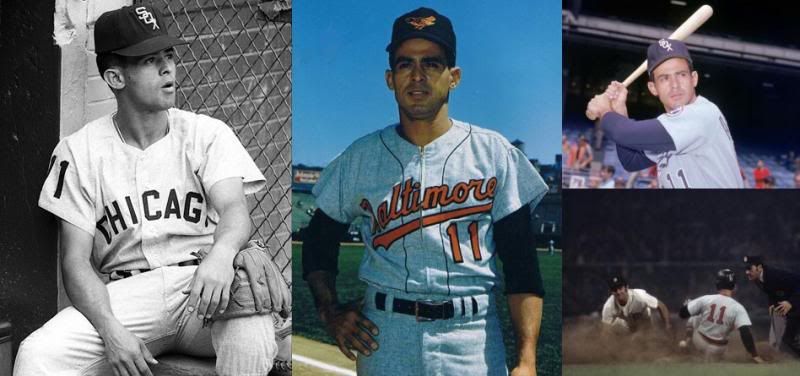
Ultimate #11: Luis Aparicio
The consistency of Luis Aparicio's career has always astounded me. In 18 seasons, he never took the field at any position besides shortstop, always played at least two-thirds of his team's games at the position, and always wore #11. With the White Sox (twice), the Orioles and the Red Sox, he's the perfect guy to represent this number.

Ultimate #12: Dusty Baker
According to Baseball-Reference, Roberto Alomar wore #12 at every stop except Arizona, where Steve Finley already had it, forcing him to wear #2. However, according to Baseball Almanac, Alomar wore both #2 and #12 for Arizona. The 2004 Diamondbacks traded away both Finley and Alomar during the season, and the Finley trade was five days before the Alomar trade. Is it possible that Alomar wore #12 in the two games he played for Arizona after the Finley trade? Without any documentation, I can't be sure. If Alomar in fact did, he would definitely be the Ultimate #12.
In the meantime, the Ultimate #12 has to be Dusty Baker, who not only wore the number at each of his four major league stops (Braves, Dodgers, Giants, Athletics), but has worn it at each managerial stop as well (Giants, Cubs, Reds). Unfortunately, I can't find pictures of Baker with a visible #12 for each of those teams, nor can I find one for any other player who potentially qualifies for the Ultimate Number Player designation, so I won't be able to include a photo collage with this one. Sorry!
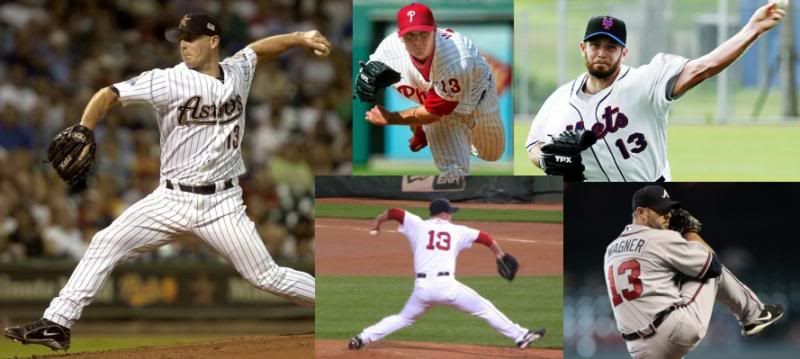
Ultimate #13: Billy Wagner
Perhaps one of the most underrated players of our era (career 187 ERA+!), Wagner wore the unlucky #13 with five teams: The Astros, Phillies, Mets, Red Sox and Braves.

Ultimate #14: Pete Rose
The rare "gritty gamer" type who was actually a Hall of Fame-level player, Rose wore #14 with his hometown Reds, the Phillies (before it was retired for Jim Bunning), the Expos in a brief stint, and the Reds again, where he broke the all-time hit record.

Ultimate #15: Davey Lopes
A legitimate Hall of Very Good second baseman, Lopes wore the number with the Dodgers, Athletics, Cubs and Astros, though there were periods with the latter two teams when he wore different numbers.
Since I can't find pictures of Lopes with a visible number 15 for each of those teams, there's going to be another substitute photo collage. The player? Kevin Millar, who also wore it with four teams: The Marlins, Red Sox, Orioles and Blue Jays. He was nowhere near the player Lopes was, but he stuck around long enough to make his mark on baseball.

Ultimate #11: Luis Aparicio
The consistency of Luis Aparicio's career has always astounded me. In 18 seasons, he never took the field at any position besides shortstop, always played at least two-thirds of his team's games at the position, and always wore #11. With the White Sox (twice), the Orioles and the Red Sox, he's the perfect guy to represent this number.
Ultimate #12: Dusty Baker
According to Baseball-Reference, Roberto Alomar wore #12 at every stop except Arizona, where Steve Finley already had it, forcing him to wear #2. However, according to Baseball Almanac, Alomar wore both #2 and #12 for Arizona. The 2004 Diamondbacks traded away both Finley and Alomar during the season, and the Finley trade was five days before the Alomar trade. Is it possible that Alomar wore #12 in the two games he played for Arizona after the Finley trade? Without any documentation, I can't be sure. If Alomar in fact did, he would definitely be the Ultimate #12.
In the meantime, the Ultimate #12 has to be Dusty Baker, who not only wore the number at each of his four major league stops (Braves, Dodgers, Giants, Athletics), but has worn it at each managerial stop as well (Giants, Cubs, Reds). Unfortunately, I can't find pictures of Baker with a visible #12 for each of those teams, nor can I find one for any other player who potentially qualifies for the Ultimate Number Player designation, so I won't be able to include a photo collage with this one. Sorry!
Ultimate #13: Billy Wagner
Perhaps one of the most underrated players of our era (career 187 ERA+!), Wagner wore the unlucky #13 with five teams: The Astros, Phillies, Mets, Red Sox and Braves.
Ultimate #14: Pete Rose
The rare "gritty gamer" type who was actually a Hall of Fame-level player, Rose wore #14 with his hometown Reds, the Phillies (before it was retired for Jim Bunning), the Expos in a brief stint, and the Reds again, where he broke the all-time hit record.

Ultimate #15: Davey Lopes
A legitimate Hall of Very Good second baseman, Lopes wore the number with the Dodgers, Athletics, Cubs and Astros, though there were periods with the latter two teams when he wore different numbers.
Since I can't find pictures of Lopes with a visible number 15 for each of those teams, there's going to be another substitute photo collage. The player? Kevin Millar, who also wore it with four teams: The Marlins, Red Sox, Orioles and Blue Jays. He was nowhere near the player Lopes was, but he stuck around long enough to make his mark on baseball.

Saturday, June 8, 2013
Ultimate Number Players: #6-10
Last time we looked at the Ultimate Player for numbers 1 through 5; this installment will include the next sequential quintet. If you need a refresher on how a player qualifies for this list, check that link.
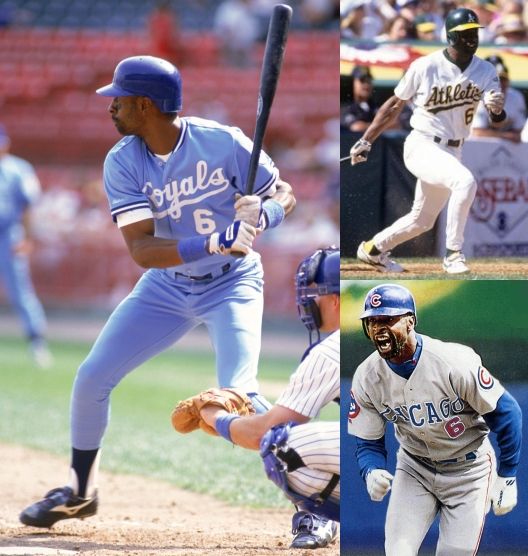
Ultimate #6: Willie Wilson
The speedster wore #6 with the Royals, Athletics and Cubs, and was easily the best of the few players who made it to three teams.

Ultimate #7: J.D. Drew
He may have been perceived as dispassionate and businesslike, but he got the number with the Cardinals, Braves, Dodgers and Red Sox.

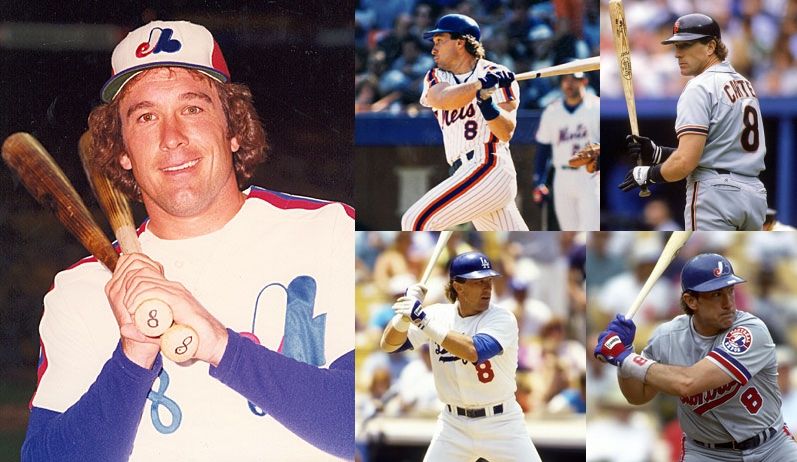
Ultimate #8: Gary Carter
It's always nice when Hall of Famers show up. Gary Carter was a no-doubter here. He was the only player to get the number with as many as four different franchises and he topped that by adding a second stint with one of those teams. In order, he had it with the Expos, Mets, Giants, Dodgers and Expos again.

Ultimate #9: Lee Stevens
This one was surprising, but the journeyman first baseman managed to get the number with the Angels, Rangers, Expos and Indians.

Ultimate #10: Lefty Grove
No player who played for more than two teams managed to wear #10 at every stop. One who did though, was possibly the greatest left-handed pitcher ever, and earned the "Ultimate Player" title for sporting it with the Athletics and Red Sox.
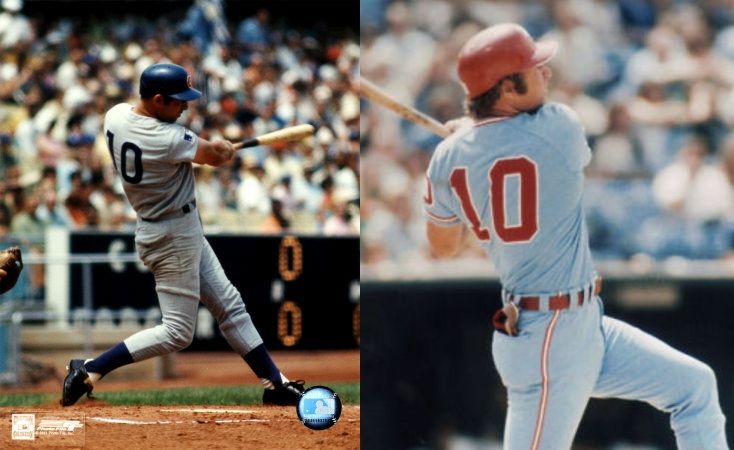
However, given that it's nearly impossible to find a single photo where Grove's #10 is visible, for the photo collage I went with another Hall of Famer who qualifies, Ron Santo, who wore it with both the Cubs and White Sox.

Next time we'll be looking at 11 through 15. Stay tuned!
Ultimate #6: Willie Wilson
The speedster wore #6 with the Royals, Athletics and Cubs, and was easily the best of the few players who made it to three teams.
Ultimate #7: J.D. Drew
He may have been perceived as dispassionate and businesslike, but he got the number with the Cardinals, Braves, Dodgers and Red Sox.

Ultimate #8: Gary Carter
It's always nice when Hall of Famers show up. Gary Carter was a no-doubter here. He was the only player to get the number with as many as four different franchises and he topped that by adding a second stint with one of those teams. In order, he had it with the Expos, Mets, Giants, Dodgers and Expos again.
Ultimate #9: Lee Stevens
This one was surprising, but the journeyman first baseman managed to get the number with the Angels, Rangers, Expos and Indians.

Ultimate #10: Lefty Grove
No player who played for more than two teams managed to wear #10 at every stop. One who did though, was possibly the greatest left-handed pitcher ever, and earned the "Ultimate Player" title for sporting it with the Athletics and Red Sox.
However, given that it's nearly impossible to find a single photo where Grove's #10 is visible, for the photo collage I went with another Hall of Famer who qualifies, Ron Santo, who wore it with both the Cubs and White Sox.
Next time we'll be looking at 11 through 15. Stay tuned!
Sunday, May 26, 2013
Ultimate Number Players: #1-5
If you read this blog regularly, you might get the sense that I love lists and trivia to the point of obsessiveness. And you'd probably be right. What better to do with this post than share another one of my obsessions?
I have an interest in uniform numbers, and I love it when a player manages to wear the same number his entire career. Of course, it's not all that impressive if he spends his entire career with one team, but when he goes through several teams and maintains the same number, that's when it becomes downright cool.
Thanks to Baseball-Reference's Uniform Number Search, we can easily find out which players wore the same number with multiple teams. However, a more interesting question (to me, at least) is which players managed to wear the same number at every stop in their careers?
I thought it'd be good to celebrate these players, and also to pick the "Ultimate Player" for each number. To be the "Ultimate Player," he must meet the following criteria:
1) The player must have worn the same number at some point for each team he played for.
2) If he had multiple stints with a team, he must have worn the number during both stints. A "stint" refers to a continuous duration of time in the organization.
3) If he left the organization at some point and returned wearing a different number, he doesn't count. (Joey Hamilton is an example of a player who was disqualified under this rule. Hamilton wore #50 with each of the three teams he played for during his career. After spending the 2002 season with the Reds, he signed as a free agent with the Cardinals and didn't make it out of Spring Training. He then went back to the Reds, but wore #54 in this second stint. As much as I wish I could include him, it doesn't seem right to me.)
4) He must have worn the number for the most teams (or stints) of any player who meets the above criteria.
5) He must no longer be active, since an active player still has the chance to lose the number with a new team.
6) In case of a tie, I'll pick the player I think was better (which usually isn't too tough a choice).
For these "Ultimate Players," I want to include a collage of their number being worn for each team. However, there's a bit of a problem there. There are a few cases where I can't find a good photo of their number being displayed while a member of that team. In those cases, my only option is to give you a collage of the best player of whom I can find good photos.
For this installment, let's look at numbers 1-5!
Ultimate #1: Richie Ashburn
Not a tough choice here, as the Hall of Fame center fielder wore it with three teams: the Phillies, Cubs and Mets. However, since Ashburn played in an era when most teams didn't have numbers on the front, it's hard to find photos where his number #1 is visible.
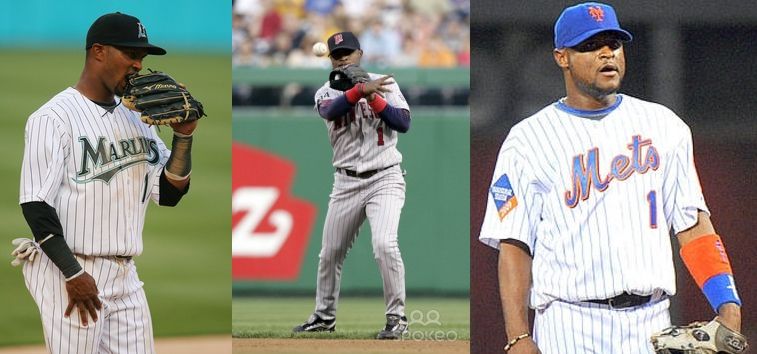
Therefore, for the photo collage, I give you another player who managed to wear #1 for three teams: Luis Castillo. He's nothing close to a Hall of Famer, but he was a fine player for several years.

Ultimate #2: Jack Wilson
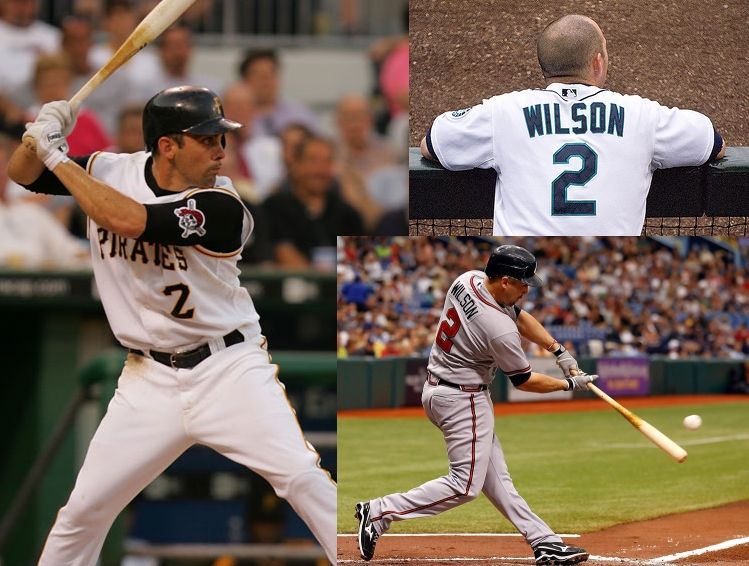
Wilson and Fred Patek are the only qualifying players I can find who made it to three teams, and it was essentially a tossup between them. I went with Wilson, since I could find good photos for him. The underrated shortstop wore it with the Pirates, Mariners and Braves during his career.
Kelly Johnson is currently at four teams, but since he's active, we can't include him yet.

Ultimate #3: Dale Murphy
Another easy choice. The Braves retired Murphy's #3, and he also wore it with the Phillies and Rockies.

Ultimate #4: Lenny Dykstra
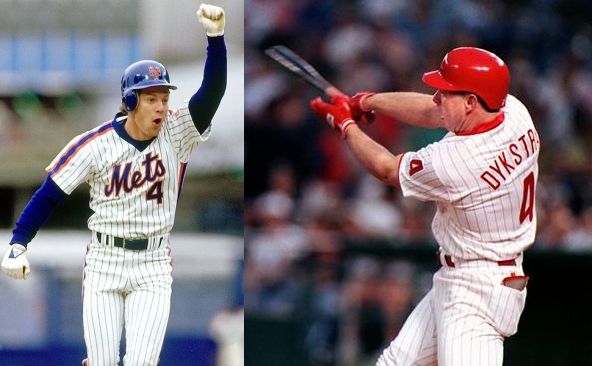
#4 doesn't have many good choices, since it's often worn by great players, and it's notoriously hard to keep throughout one's career. Therefore, the best I can give you is Lenny Dykstra of the Mets and Phillies.
Hall of Famer Joe Cronin sort of qualifies, but because he played for the Pirates during the pre-uniform number era, it didn't seem quite right. Journeyman infielder Pete Orr is currently sitting on three teams, and if he never plays another game in the majors, he'll become the Ultimate #4. What a strange circumstance that'd be. I'm sure that Bobby Orr, whom he wears the number in tribute to, would be proud.

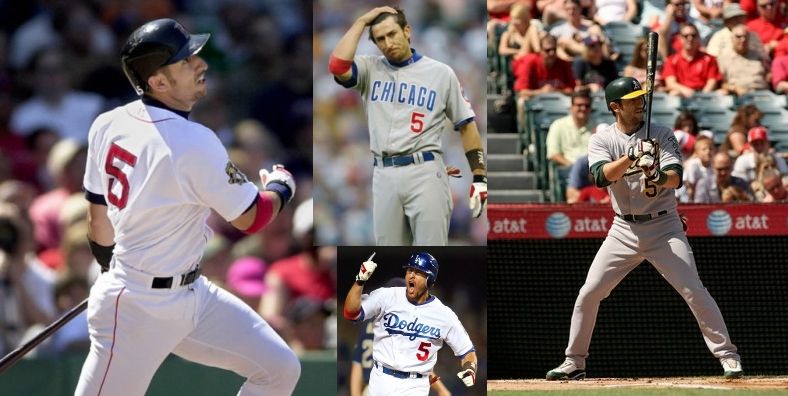
Ultimate #5: Nomar Garciaparra
A guy who had six Hall of Fame-level seasons and little else, Garciaparra wore the number with the Red Sox, Cubs, Dodgers and Athletics.

I have an interest in uniform numbers, and I love it when a player manages to wear the same number his entire career. Of course, it's not all that impressive if he spends his entire career with one team, but when he goes through several teams and maintains the same number, that's when it becomes downright cool.
Thanks to Baseball-Reference's Uniform Number Search, we can easily find out which players wore the same number with multiple teams. However, a more interesting question (to me, at least) is which players managed to wear the same number at every stop in their careers?
I thought it'd be good to celebrate these players, and also to pick the "Ultimate Player" for each number. To be the "Ultimate Player," he must meet the following criteria:
1) The player must have worn the same number at some point for each team he played for.
2) If he had multiple stints with a team, he must have worn the number during both stints. A "stint" refers to a continuous duration of time in the organization.
3) If he left the organization at some point and returned wearing a different number, he doesn't count. (Joey Hamilton is an example of a player who was disqualified under this rule. Hamilton wore #50 with each of the three teams he played for during his career. After spending the 2002 season with the Reds, he signed as a free agent with the Cardinals and didn't make it out of Spring Training. He then went back to the Reds, but wore #54 in this second stint. As much as I wish I could include him, it doesn't seem right to me.)
4) He must have worn the number for the most teams (or stints) of any player who meets the above criteria.
5) He must no longer be active, since an active player still has the chance to lose the number with a new team.
6) In case of a tie, I'll pick the player I think was better (which usually isn't too tough a choice).
For these "Ultimate Players," I want to include a collage of their number being worn for each team. However, there's a bit of a problem there. There are a few cases where I can't find a good photo of their number being displayed while a member of that team. In those cases, my only option is to give you a collage of the best player of whom I can find good photos.
For this installment, let's look at numbers 1-5!
Ultimate #1: Richie Ashburn
Not a tough choice here, as the Hall of Fame center fielder wore it with three teams: the Phillies, Cubs and Mets. However, since Ashburn played in an era when most teams didn't have numbers on the front, it's hard to find photos where his number #1 is visible.
Therefore, for the photo collage, I give you another player who managed to wear #1 for three teams: Luis Castillo. He's nothing close to a Hall of Famer, but he was a fine player for several years.
Ultimate #2: Jack Wilson
Wilson and Fred Patek are the only qualifying players I can find who made it to three teams, and it was essentially a tossup between them. I went with Wilson, since I could find good photos for him. The underrated shortstop wore it with the Pirates, Mariners and Braves during his career.
Kelly Johnson is currently at four teams, but since he's active, we can't include him yet.
Ultimate #3: Dale Murphy
Another easy choice. The Braves retired Murphy's #3, and he also wore it with the Phillies and Rockies.

Ultimate #4: Lenny Dykstra
#4 doesn't have many good choices, since it's often worn by great players, and it's notoriously hard to keep throughout one's career. Therefore, the best I can give you is Lenny Dykstra of the Mets and Phillies.
Hall of Famer Joe Cronin sort of qualifies, but because he played for the Pirates during the pre-uniform number era, it didn't seem quite right. Journeyman infielder Pete Orr is currently sitting on three teams, and if he never plays another game in the majors, he'll become the Ultimate #4. What a strange circumstance that'd be. I'm sure that Bobby Orr, whom he wears the number in tribute to, would be proud.
Ultimate #5: Nomar Garciaparra
A guy who had six Hall of Fame-level seasons and little else, Garciaparra wore the number with the Red Sox, Cubs, Dodgers and Athletics.
Monday, April 22, 2013
Canadians Playing Baseball in Canada
For some reason, I've always liked Canada's MLB teams. The Expos were the first team I considered my favorite (long story), and that fondness carries over to the current-day Nationals. The Blue Jays were the visiting team in the first ballgame I ever attended, and their classic uniforms are one of my all-time favorites (their return to this look may give them to top spot if I were to rank all of MLB's uniforms again). I may not be Canadian, but I can appreciate the country's baseball offerings.
A while back, someone on a message board posed the question of how many Canadian players played for the Expos and Blue Jays. It made me curious, so I decided to find out the answer. I counted a player as "Canadian" if he was born in Canada, because I don't have time to research whether a player may have moved there after being born somewhere else.
The answers I came up with were:
Expos (16): Claude Raymond, Larry Landreth, Bill Atkinson, Doug Frobel, Larry Walker, Dave Wainhouse, Matt Maysey, Matt Stairs, Denis Boucher, Mike Gardiner, Joe Siddall, Derek Aucoin, Rheal Cormier, Mike Johnson, Rob Ducey, Shawn Hill.
Blue Jays (17): Dave McKay, Paul Hodgson, Rob Ducey, Vince Horsman, Denis Boucher, Rob Butler, Paul Spoljaric, Paul Quantrill, Rich Butler, Steve Sinclair, Simon Pond, Corey Koskie, Matt Stairs, Scott Richmond, Shawn Hill, Adam Loewen, Brett Lawrie.
Several players, as you might have noticed, appeared on both lists, namely Matt Stairs, Denis Boucher, Rob Ducey and Shawn Hill. Only these four men can claim to be Canadian-born and to have played for both Canadian teams.
If I had more time, I could look into the question of which MLB team had the most Canadian-born players in one season, but right now, I can only answer for the Expos and Blue Jays.
The 1993 Expos had five Canadians (Boucher, Gardiner, Siddell, Stairs, Walker) and the 1999 Blue Jays had four Canadians (Rob Butler, Quantrill, Sinclair, Spoljaric).
Is there any team that had more than five? Perhaps someday this blog will be able to answer that question.
One thing I noticed while researching this information was that the 1980's seemed to be a low point for Canadian baseball players. There was no shortage of them in the previous decades, and in the 1990's there was a new wave of them, but not many came up during the 1980's. I have no idea why that is. Perhaps Canadian baseball culture in the '60s and '70s was weak? Could the '90s boom be attributed to the successes of the Expos and Blue Jays? I'd be interested in hearing from someone who knows.
A while back, someone on a message board posed the question of how many Canadian players played for the Expos and Blue Jays. It made me curious, so I decided to find out the answer. I counted a player as "Canadian" if he was born in Canada, because I don't have time to research whether a player may have moved there after being born somewhere else.
The answers I came up with were:
Expos (16): Claude Raymond, Larry Landreth, Bill Atkinson, Doug Frobel, Larry Walker, Dave Wainhouse, Matt Maysey, Matt Stairs, Denis Boucher, Mike Gardiner, Joe Siddall, Derek Aucoin, Rheal Cormier, Mike Johnson, Rob Ducey, Shawn Hill.
Blue Jays (17): Dave McKay, Paul Hodgson, Rob Ducey, Vince Horsman, Denis Boucher, Rob Butler, Paul Spoljaric, Paul Quantrill, Rich Butler, Steve Sinclair, Simon Pond, Corey Koskie, Matt Stairs, Scott Richmond, Shawn Hill, Adam Loewen, Brett Lawrie.
Several players, as you might have noticed, appeared on both lists, namely Matt Stairs, Denis Boucher, Rob Ducey and Shawn Hill. Only these four men can claim to be Canadian-born and to have played for both Canadian teams.
If I had more time, I could look into the question of which MLB team had the most Canadian-born players in one season, but right now, I can only answer for the Expos and Blue Jays.
The 1993 Expos had five Canadians (Boucher, Gardiner, Siddell, Stairs, Walker) and the 1999 Blue Jays had four Canadians (Rob Butler, Quantrill, Sinclair, Spoljaric).
Is there any team that had more than five? Perhaps someday this blog will be able to answer that question.
One thing I noticed while researching this information was that the 1980's seemed to be a low point for Canadian baseball players. There was no shortage of them in the previous decades, and in the 1990's there was a new wave of them, but not many came up during the 1980's. I have no idea why that is. Perhaps Canadian baseball culture in the '60s and '70s was weak? Could the '90s boom be attributed to the successes of the Expos and Blue Jays? I'd be interested in hearing from someone who knows.
Subscribe to:
Posts (Atom)