
Manager: Joe Altobelli
Record: 98-64
Ballpark: Memorial Stadium
Owner: Edward Bennett Williams
GM: Hank Peters
Coaches: Elrod Hendricks, Ray Miller, Cal Ripken, Ralph Rowe, Jimmy Williams
Future Hall of Famers: Eddie Murray, Jim Palmer, Cal Ripken Jr.
All-Stars: Tippy Martinez, Eddie Murray, Cal Ripken Jr.
Team Leaders, Batting
BA: Cal Ripken, .318
OBP: Eddie Murray, Ken Singleton, .393
SLG: Eddie Murray, .538
OPS: Eddie Murray, .930
2B: Cal Ripken, 47 (AL leader)
3B: Al Bumbry, Dan Ford, 4
HR: Eddie Murray, 33
RBI: Eddie Murray, 111
BB: Ken Singleton, 99
SB: John Shelby, 15
Team Leaders, Pitching
W: Scott McGregor, 18
SO: Storm Davis, 125
ERA: Mike Boddicker, 2.77
IP: Scott McGregor, 260.0
CG: Scott McGregor, 12
SHO: Mike Boddicker, 5 (AL leader)
K/BB: Mike Boddicker, 2.31
SV: Tippy Martinez, 21
Tidbits
Oldest Player: Jim Palmer (b. October 15, 1945)
Youngest Player: Storm Davis (b. December 26, 1961)
First to Leave Us: Aurelio Rodriguez (d. September 23, 2000). While a pedestrian walking the streets of Detroit, Rodriguez was struck by a vehicle that veered off the road.
Last Survivor: Most are still living as of the date of this post.
First in Majors: Jim Palmer (debut April 17, 1965)
Last in Majors: Cal Ripken (final game October 6, 2001)
First to Play For the Franchise: Jim Palmer (April 17, 1965)
Last to Play For the Franchise: Cal Ripken (October 6, 2001)
Pre-union Team: No team had more than two.
Reunion Team: The 1986 Yankees (Leo Hernandez, Gary Roenicke and Tim Stoddard) and 1989-90 Dodgers (Rick Dempsey, Eddie Murray and John Shelby) each had three.
Accomplishments
Cal Ripken, AL MVP
Eddie Murray, AL First Base Gold Glove
Eddie Murray, AL First Base Silver Slugger
Cal Ripken, AL Shortstop Silver Slugger
Season Summary
The 1982 AL East division race was a classic. The Baltimore Orioles and Milwaukee Brewers were scheduled for a four-game set to close out the season, with Milwaukee needing only one win to clinch the title. The Orioles, however, weren't going to roll over, as longtime manager Earl Weaver was set to retire, and they won the first three games to force a winner-take-all showdown on the last day of the season. Unfortunatley for Baltimore, the magic ran out there, as the Brewers romped to their first-ever division title.
Despite coming up a game short in '82, the Orioles' late-season momentum gave them optimism heading into the next season. Their core of players remained intact, and the general consensus on the club was that 1983 was going to be their year. Taking Weaver's spot in the dugout was Yankee third base coach Joe Altobelli, who was familiar with several players on the roster due to having previously managed the Orioles' top farm club in Rochester. Altobelli lacked Weaver's large personality, but he was a good man to keep the ship on the course it had begun.
The Orioles were a typical team built in the mold of Earl Weaver: Baltimore led the league in home runs and on-base percentage, while stealing few bases, employing platoons, and playing solid defense behind a sturdy pitching staff. They had two big stars in Eddie Murray, a consistently productive slugger and steady presence at first base, and Cal Ripken Jr., the 1982 Rookie of the Year and son of third base coach Cal Ripken Sr. The young Ripken played every inning at shortstop for the '83 Birds, and was a powerful force on both offense and defense who would be named league MVP for his work that season. Beyond that, the Orioles' strength was their depth of talent.
After getting off to slow starts the previous few years, the Orioles finished April a half-game in first place and stayed above .500 for the rest of the season. The American League East was a strong division in 1983, with five of the seven teams finishing with winning records, and all but the last-place Indians coming within a game of first place at some point after May. The Orioles fell behind different rivals at various points of the season: The Red Sox in May, the Blue Jays in June and July, and the Brewers and Tigers in August. However, an eight-game winning streak at the end of August catapulted them into first place for good. They paid back the Brewers for clinching on their turf the previous season by going to Milwaukee and wrapping up the divison title in County Stadium behind young fireballer Storm Davis.
The Orioles didn't make any huge transactions that season, but there were two worth noting: The trade for reserve outfielder Tito Landrum from the Cardinals and the purchase of infielder Todd Cruz from the Mariners. The Orioles had been weak at third base all year, between young Leo Hernandez, a weak defender whose bat hadn't delivered on the promise of his minor league numbers, and veteran Aurelio Rodriguez, who could still play strong defense but couldn't hit a lick. Cruz plugged the hole at third, and while he wasn't the glove man Rodriguez was, or even the hitter Hernandez was, he proved to be a better all-around option. As for Landrum, he would provide a significant moment in October.
The ALCS pitted the Orioles against the Chicago White Sox, who'd had a strong second half to run away with a weak AL West division. The Sox won Game 1 when their ace, Cy Young winner LaMarr Hoyt, outdueled Baltimore ace Scott McGregor 2-1. Undeterred, the Orioles bounced back in Game 2 with a shutout from rookie Mike Boddicker. Boddicker had begun the season in the minors, but he joined the big club in May to give the rotation a boost, and he didn't disappoint. Shutouts were something of a specialty of his; he threw one in his first start of the season, and led the league with five scoreless outings. Now he'd thrown another to get his team back on track. When the series shifted to Chicago, the O's spoiled things for the hometown fans by drubbing the Sox 11-1 in Game 3.
With one win still needed for a pennant, the Orioles sent Storm Davis to the mound, while the Pale Hose sent lefty Britt Burns. It was a tight battle, with a scoreless game and both starters still duking it out in the seventh inning. When White Sox first baseman Greg Walker led off the bottom of the inning with a single, Altobelli pulled Davis in favor of relief ace Tippy Martinez. The Sox got runners on first and second with one out, and Julio Cruz singled to left. Sox runner Jerry Dybzinski, who didn't realize that lead runner Vance Law was being held at third, got caught between the bases, and when the Oriole defense threw to second, Law broke for home attempting to score on the play, where he was thrown out. The Orioles escaped the inning unscathed, and the game remained scoreless till the end of regulation.
In the tenth inning, with Burns still chugging along for the White Sox, Tito Landrum came up to bat with one out. Landrum, not known for his power, finally put a run on the board with a solo homer to left. The Orioles would score two more against the White Sox bullpen to take a 3-0 lead into the bottom of the tenth, where Martinez closed it out with little incident. For the first time in four years, the Orioles were American League champions. Baltimore's run prevention had carried them, as they allowed only three White Sox runs in the four games. For his masterful effort in Game 2, Mike Boddicker was named ALCS MVP.
The World Series with the veteran-laden Philadelphia Phillies bore some resemblance to the LCS; in Game 1 the Orioles faced a Cy Young winner at Memorial Stadium, this time John Denny, and lost 2-1. Game 2 was once again started by young Boddicker, and while he didn't throw a shutout, he allowed only one run in a complete game victory. Going on the road for Games 3 through 5, the Orioles were unfazed by the crowd in Philly; they won Games 3 and 4 by one run each, then handed the ball to McGregor for Game 5, where he pitched a shutout to clinch the title. It was Baltimore's first World Series championship since 1970. Catcher Rick Dempsey was named World Series MVP for his .385 batting average, two RBI, and five extra-base hits.
Acknowledgements:
Baseball Reference
Retrosheet
Baseball Almanac
Google News Archives
Cal Ripken Jr, The Only Way I Know
Showing posts with label Profiling the World Series Winners. Show all posts
Showing posts with label Profiling the World Series Winners. Show all posts
Tuesday, August 29, 2017


Saturday, July 29, 2017
PTWSW #79: The 1982 St. Louis Cardinals
Manager: Whitey Herzog
Record: 92-70
Ballpark: Busch Memorial Stadium
Owner: August Busch Jr.
GM: Joe McDonald
Coaches: Chuck Hiller, Hub Kittle, Hal Lanier, Dave Ricketts, Red Schoendienst
Future Hall of Famers: Ozzie Smith, Bruce Sutter
All-Stars: Lonnie Smith, Ozzie Smith
Team Leaders, Batting
BA: Lonnie Smith, .307
OBP: Keith Hernandez, .397
SLG: George Hendrick, .450
OPS: Lonnie Smith, .815
2B: Lonnie Smith, 35
3B: Lonnie Smith, Willie McGee, 8
HR: George Hendrick, 19
RBI: George Hendrick, 104
BB: Keith Hernandez, 100
SB: Lonnie Smith, 68
Team Leaders, Pitching
W: Joaquin Andujar, Bob Forsch, 15
SO: Joaquin Andujar, 137
ERA: Joaquin Andujar, 2.47
IP: Joaquin Andujar, 265.2
CG: Joaquin Andujar, 9
SHO: Joaquin Andujar, 5
K/BB: Joaquin Andujar, 2.74
SV: Bruce Sutter, 36 (NL leader)
Tidbits
Oldest Player: Jim Kaat (b. November 7, 1938)
Youngest Player: David Green (b. December 4, 1960)
First to Leave Us: Darrell Porter (d. August 5, 2002)
Last Survivor: Most are still living as of the date of this post.
First in Majors: Jim Kaat (debut August 2, 1959)
Last in Majors: Willie McGee (final game October 3, 1999)
First to Play For the Franchise: Bob Forsch (July 7, 1974)
Last to Play For the Franchise: Willie McGee (October 3, 1999)
Pre-union Team: The 1978 San Diego Padres had five: George Hendrick, Steve Mura, Eric Rasmussen, Ozzie Smith, and Gene Tenace.
Reunion Team: The 1983 Detroit Tigers (Doug Bair, Julio Gonzalez, and John Martin) and 1988 Atlanta Braves (Ken Oberkfell, Lonnie Smith, and Bruce Sutter) had three each.
Accomplishments
Keith Hernandez, NL First Base Gold Glove
Ozzie Smith, NL Shortstop Gold Glove
Season Summary
In 1980, the once-proud St. Louis Cardinals had spent a decade mired in mediocrity. Poor hiring choices, ill-conceived trades, and the stale leadership of company men had resulted in no postseason appearances since the NL pennant of 1968. In early June, the Cardinals found themselves with the worst record in baseball, which led to the firing of former Redbird great Ken Boyer as manager. To replace him, the Cards hired Whitey Herzog, whom the Royals had controversially fired at the end of 1979, just one year removed from a run of three straight division titles.
There was definite talent on the team Herzog inherited, which showed itself once he took the reins. With Whitey at the helm, the Cards went on a 38-35 run before Herzog handed the reins to Red Schoendienst, allowing himself to finish the season as general manager. It was as GM that Herzog would remake the Cardinals into the team he wanted; out were longtime slugging catcher Ted Simmons and longtime slow-footed third baseman Ken Reitz, who had started the 1980 All-Star Game. To replace them, Herzog brought in free agent backstop Darrell Porter, who'd played for him in Kansas City, and young infielder Ken Oberkfell took over the hot corner. He also landed All-Star closer Bruce Sutter from the Cubs to handle ninth inning duties.
With their revamped roster, the Cardinals might've won it all in 1981. With Herzog doing double duty as field manager and general manager, St. Louis finished with the best record in the National League East. Unfortunately, due to the mid-season strike, the playoff format required a team to have the best record in their division for either the first or second half of the season, neither of which the Cardinals accomplished. The Cardinals spent that October watching the postseason on television, and Herzog prepared himself for another busy offseason.
In October, the Cards acquired a minor league outfielder named Willie McGee from the Yankees in exchange for pitcher Bob Sykes. The move wasn't flashy, and it was overshadowed by the Yankees playing in the World Series at the time, but it would prove significant. Herzog would also re-sign free agent pitcher Joaquin Andujar, grab outfielder Lonnie Smith from the Phillies, and trade talented-but-troubled shortstop Garry Templeton to the Padres. The key player the Cardinals got back from San Diego? A little shortstop with an outstanding glove by the name of Osborne Earl Smith. Little did anyone at the time know that Ozzie Smith would spend 15 seasons in a Cardinal uniform.
After getting off to a 1-3 start, Herzog relinquished his GM duties and stuck to managing full time. The Cardinals then went on a 12-game winning streak, propelling them into the pennant race early. McGee, the promising young outfielder, made his major league debut in May, and quickly became the full-time center fielder, allowing Lonnie Smith to take his more natural position in left field. The Redbirds struggled a bit in June, and by the All-Star break, they were in a close race with the Phillies for the division title.
Both teams continued their winning ways through the second half, and on August 12, the Cardinals regained first place. They brought their lead up to 3.5 games on September 1, only to see it slip away when a slump coincided with a Philly hot stretch. On September 13, with the Cardinals holding a half-game lead, the two teams met for a three-game series at Veterans Stadium. The Phillies took the first match (as well as first place) behind Steve Carlton's three-hit complete game shutout. Not to be outdone, the Cardinals roared back by not allowing any runs in the next two games. Joaquin Andujar pitched a three-hit complete game shutout of his own in the third contest. It was the start of an eight-game winning streak, which gave the Cardinals the division lead they'd hold for the rest of the season. On September 27 against the Expos, the Cardinals clinched their first-ever NL East title.
Whitey Herzog had truly created a team in his own image. With McGee, the two Smiths, and Tommy Herr leading the way, the Cardinals topped the league with 200 stolen bases, while finishing last with a paltry 67 home runs. They tied San Diego for the lead in triples, and they were first in on-base percentage, thanks to finishing second in both batting average and walks. Their pitchers struck out the fewest batters in the league, but they made up for it by allowing few homers, and their fielding was among the best in the NL.
The National League Championship Series matched the Cardinals with the Atlanta Braves, who were appearing in the postseason for the first time since 1969. Game 1 was initially rained out with the Braves leading 1-0, and when the game was replayed, the Cardinals won easily, as Bob Forsch pitched a 7-0 shutout. Game 2 was the only close one of the series; it was a tie ballgame in the bottom of the ninth when Ken Oberkfell's drive just got past Brett Butler's glove in center field, scoring David Green with the game-winner. The series shifted to Atlanta, but Game 3 proved to be another easy victory for St. Louis, allowing them to complete the sweep and make it back to the World Series for the first time in 14 years.
The American League's representative was the Milwaukee Brewers, playing in the franchise's first World Series, who had come back from a 2-0 deficit in the ALCS to beat the Angels. On the Brewers' roster were three players Herzog had traded away during the wheeling-and-dealing 1980-81 offseason: Former franchise icon Ted Simmons, 18-game winner Pete Vuckovich, who would win the Cy Young that year, and injured closer Rollie Fingers, who wouldn't see action in the World Series. Of the players the Cardinals had received back in that deal, two were still on the roster (David Green and Dave LaPoint), one was included in the deal for Ozzie Smith (Sixto Lezcano), and the other was included in the deal for Lonnie Smith (Lary Sorensen). The Brewers were in many ways the Cardinals' opposite: They won mostly by slugging home runs, and weren't big on base-stealing. Their pitching and defense were average at best, and they relied on hits much more than walks.
The Brewers won Game 1 in a blowout, by a score of 10-0. Milwaukee's dynamic duo of Robin Yount and Paul Molitor combined for nine hits and four runs driven in. The resilient Cardinals bounced back, however, with wins in Games 2 and 3. The Cards' Game 2 win came on Steve Braun's bases-loaded walk in the eighth inning, and Willie McGee's two homers powered them to victory in Game 3. The Brewers wouldn't quit though, and they won the next two to take a 3-2 series lead. The Brew Crew took Game 4 thanks to a six-run seventh inning, and Game 5 saw Yount put up his second four-hit game of the series.
Back at Busch for Game 6, the Cardinals returned the favor from Game 1 by blowing out the Brewers 13-1. St. Louis starter John Stuper went the distance, allowing only four hits and two walks in the must-win game. That set the stage for Game 7, which pitted Vuckovich against Andujar, who was returning from an injury in Game 3. After five innings, the game was tied at one apiece, but the Brewers scored two in the top of the sixth to take the lead. The Cardinals were unfazed, however, scoring three of their own in the bottom half to go ahead 4-3. They would never trail the rest of the way. Andujar completed seven innings, and Bruce Sutter came in for the final two, retiring all six batters he faced to close out both the game and the series.
In just two years, Whitey Herzog had turned the Cardinals from a mediocre also-ran to a World Series champion. It was the first championship ring of his career, and he had done it his way. For St. Louis fans, it was the first time they'd won it all since 1967, when Bob Gibson, Lou Brock, and company were still in their primes. It was the beginning of what was to be a successful era in the Gateway City.
Acknowledgements:
Baseball Reference
Baseball Almanac
Google News Archives
Retrosheet
New York Times: Cardinals Are Baseball's Mystery Team
1982 NLCS on Wikipedia
Record: 92-70
Ballpark: Busch Memorial Stadium
Owner: August Busch Jr.
GM: Joe McDonald
Coaches: Chuck Hiller, Hub Kittle, Hal Lanier, Dave Ricketts, Red Schoendienst
Future Hall of Famers: Ozzie Smith, Bruce Sutter
All-Stars: Lonnie Smith, Ozzie Smith
Team Leaders, Batting
BA: Lonnie Smith, .307
OBP: Keith Hernandez, .397
SLG: George Hendrick, .450
OPS: Lonnie Smith, .815
2B: Lonnie Smith, 35
3B: Lonnie Smith, Willie McGee, 8
HR: George Hendrick, 19
RBI: George Hendrick, 104
BB: Keith Hernandez, 100
SB: Lonnie Smith, 68
Team Leaders, Pitching
W: Joaquin Andujar, Bob Forsch, 15
SO: Joaquin Andujar, 137
ERA: Joaquin Andujar, 2.47
IP: Joaquin Andujar, 265.2
CG: Joaquin Andujar, 9
SHO: Joaquin Andujar, 5
K/BB: Joaquin Andujar, 2.74
SV: Bruce Sutter, 36 (NL leader)
Tidbits
Oldest Player: Jim Kaat (b. November 7, 1938)
Youngest Player: David Green (b. December 4, 1960)
First to Leave Us: Darrell Porter (d. August 5, 2002)
Last Survivor: Most are still living as of the date of this post.
First in Majors: Jim Kaat (debut August 2, 1959)
Last in Majors: Willie McGee (final game October 3, 1999)
First to Play For the Franchise: Bob Forsch (July 7, 1974)
Last to Play For the Franchise: Willie McGee (October 3, 1999)
Pre-union Team: The 1978 San Diego Padres had five: George Hendrick, Steve Mura, Eric Rasmussen, Ozzie Smith, and Gene Tenace.
Reunion Team: The 1983 Detroit Tigers (Doug Bair, Julio Gonzalez, and John Martin) and 1988 Atlanta Braves (Ken Oberkfell, Lonnie Smith, and Bruce Sutter) had three each.
Accomplishments
Keith Hernandez, NL First Base Gold Glove
Ozzie Smith, NL Shortstop Gold Glove
Season Summary
In 1980, the once-proud St. Louis Cardinals had spent a decade mired in mediocrity. Poor hiring choices, ill-conceived trades, and the stale leadership of company men had resulted in no postseason appearances since the NL pennant of 1968. In early June, the Cardinals found themselves with the worst record in baseball, which led to the firing of former Redbird great Ken Boyer as manager. To replace him, the Cards hired Whitey Herzog, whom the Royals had controversially fired at the end of 1979, just one year removed from a run of three straight division titles.
There was definite talent on the team Herzog inherited, which showed itself once he took the reins. With Whitey at the helm, the Cards went on a 38-35 run before Herzog handed the reins to Red Schoendienst, allowing himself to finish the season as general manager. It was as GM that Herzog would remake the Cardinals into the team he wanted; out were longtime slugging catcher Ted Simmons and longtime slow-footed third baseman Ken Reitz, who had started the 1980 All-Star Game. To replace them, Herzog brought in free agent backstop Darrell Porter, who'd played for him in Kansas City, and young infielder Ken Oberkfell took over the hot corner. He also landed All-Star closer Bruce Sutter from the Cubs to handle ninth inning duties.
With their revamped roster, the Cardinals might've won it all in 1981. With Herzog doing double duty as field manager and general manager, St. Louis finished with the best record in the National League East. Unfortunately, due to the mid-season strike, the playoff format required a team to have the best record in their division for either the first or second half of the season, neither of which the Cardinals accomplished. The Cardinals spent that October watching the postseason on television, and Herzog prepared himself for another busy offseason.
In October, the Cards acquired a minor league outfielder named Willie McGee from the Yankees in exchange for pitcher Bob Sykes. The move wasn't flashy, and it was overshadowed by the Yankees playing in the World Series at the time, but it would prove significant. Herzog would also re-sign free agent pitcher Joaquin Andujar, grab outfielder Lonnie Smith from the Phillies, and trade talented-but-troubled shortstop Garry Templeton to the Padres. The key player the Cardinals got back from San Diego? A little shortstop with an outstanding glove by the name of Osborne Earl Smith. Little did anyone at the time know that Ozzie Smith would spend 15 seasons in a Cardinal uniform.
After getting off to a 1-3 start, Herzog relinquished his GM duties and stuck to managing full time. The Cardinals then went on a 12-game winning streak, propelling them into the pennant race early. McGee, the promising young outfielder, made his major league debut in May, and quickly became the full-time center fielder, allowing Lonnie Smith to take his more natural position in left field. The Redbirds struggled a bit in June, and by the All-Star break, they were in a close race with the Phillies for the division title.
Both teams continued their winning ways through the second half, and on August 12, the Cardinals regained first place. They brought their lead up to 3.5 games on September 1, only to see it slip away when a slump coincided with a Philly hot stretch. On September 13, with the Cardinals holding a half-game lead, the two teams met for a three-game series at Veterans Stadium. The Phillies took the first match (as well as first place) behind Steve Carlton's three-hit complete game shutout. Not to be outdone, the Cardinals roared back by not allowing any runs in the next two games. Joaquin Andujar pitched a three-hit complete game shutout of his own in the third contest. It was the start of an eight-game winning streak, which gave the Cardinals the division lead they'd hold for the rest of the season. On September 27 against the Expos, the Cardinals clinched their first-ever NL East title.
Whitey Herzog had truly created a team in his own image. With McGee, the two Smiths, and Tommy Herr leading the way, the Cardinals topped the league with 200 stolen bases, while finishing last with a paltry 67 home runs. They tied San Diego for the lead in triples, and they were first in on-base percentage, thanks to finishing second in both batting average and walks. Their pitchers struck out the fewest batters in the league, but they made up for it by allowing few homers, and their fielding was among the best in the NL.
The National League Championship Series matched the Cardinals with the Atlanta Braves, who were appearing in the postseason for the first time since 1969. Game 1 was initially rained out with the Braves leading 1-0, and when the game was replayed, the Cardinals won easily, as Bob Forsch pitched a 7-0 shutout. Game 2 was the only close one of the series; it was a tie ballgame in the bottom of the ninth when Ken Oberkfell's drive just got past Brett Butler's glove in center field, scoring David Green with the game-winner. The series shifted to Atlanta, but Game 3 proved to be another easy victory for St. Louis, allowing them to complete the sweep and make it back to the World Series for the first time in 14 years.
The American League's representative was the Milwaukee Brewers, playing in the franchise's first World Series, who had come back from a 2-0 deficit in the ALCS to beat the Angels. On the Brewers' roster were three players Herzog had traded away during the wheeling-and-dealing 1980-81 offseason: Former franchise icon Ted Simmons, 18-game winner Pete Vuckovich, who would win the Cy Young that year, and injured closer Rollie Fingers, who wouldn't see action in the World Series. Of the players the Cardinals had received back in that deal, two were still on the roster (David Green and Dave LaPoint), one was included in the deal for Ozzie Smith (Sixto Lezcano), and the other was included in the deal for Lonnie Smith (Lary Sorensen). The Brewers were in many ways the Cardinals' opposite: They won mostly by slugging home runs, and weren't big on base-stealing. Their pitching and defense were average at best, and they relied on hits much more than walks.
The Brewers won Game 1 in a blowout, by a score of 10-0. Milwaukee's dynamic duo of Robin Yount and Paul Molitor combined for nine hits and four runs driven in. The resilient Cardinals bounced back, however, with wins in Games 2 and 3. The Cards' Game 2 win came on Steve Braun's bases-loaded walk in the eighth inning, and Willie McGee's two homers powered them to victory in Game 3. The Brewers wouldn't quit though, and they won the next two to take a 3-2 series lead. The Brew Crew took Game 4 thanks to a six-run seventh inning, and Game 5 saw Yount put up his second four-hit game of the series.
Back at Busch for Game 6, the Cardinals returned the favor from Game 1 by blowing out the Brewers 13-1. St. Louis starter John Stuper went the distance, allowing only four hits and two walks in the must-win game. That set the stage for Game 7, which pitted Vuckovich against Andujar, who was returning from an injury in Game 3. After five innings, the game was tied at one apiece, but the Brewers scored two in the top of the sixth to take the lead. The Cardinals were unfazed, however, scoring three of their own in the bottom half to go ahead 4-3. They would never trail the rest of the way. Andujar completed seven innings, and Bruce Sutter came in for the final two, retiring all six batters he faced to close out both the game and the series.
In just two years, Whitey Herzog had turned the Cardinals from a mediocre also-ran to a World Series champion. It was the first championship ring of his career, and he had done it his way. For St. Louis fans, it was the first time they'd won it all since 1967, when Bob Gibson, Lou Brock, and company were still in their primes. It was the beginning of what was to be a successful era in the Gateway City.
Acknowledgements:
Baseball Reference
Baseball Almanac
Google News Archives
Retrosheet
New York Times: Cardinals Are Baseball's Mystery Team
1982 NLCS on Wikipedia
Sunday, January 22, 2012
PTWSW #78: The 1981 Los Angeles Dodgers
Manager: Tommy Lasorda
Record: 63-47
Ballpark: Dodger Stadium
Owner: Peter O'Malley & Terry Seidler
GM: Al Campanis
Coaches: Monty Basgall, Mark Cresse, Manny Mota, Danny Ozark, Ron Perranoski
Future Hall of Famers: none
All-Stars: Dusty Baker, Steve Garvey, Pedro Guerrero, Burt Hooton, Davey Lopes, Fernando Valenzuela
Team Leaders, Batting
BA: Dusty Baker, .320
OBP: Ron Cey, .372
SLG: Ron Cey, .474
OPS: Ron Cey, .846
2B: Steve Garvey, 23
3B: Ken Landreaux, 4
HR: Ron Cey, 13
RBI: Steve Garvey, 64
BB: Ron Cey, 40
SB: Davey Lopes, 20
Team Leaders, Pitching
W: Fernando Valenzuela, 13
SO: Fernando Valenzuela, 180 (NL leader)
ERA: Burt Hooton, 2.28
IP: Fernando Valenzuela, 192.1 (NL leader)
CG: Fernando Valenzuela, 11 (NL leader)
SHO: Fernando Valenzuela, 8 (NL leader)
K/BB: Fernando Valenzuela, 2.95
SV: Steve Howe, 8
Tidbits
Oldest Player: Jerry Grote (b. October 6, 1942)
Youngest Player: Fernando Valenzuela (b. November 1, 1960)
First to Leave Us: Steve Howe (d. April 28, 2006). Howe was only 48 years old when he died in a pickup truck accident.
Last Survivor: Most are still living as of the date of this post.
First in Majors: Jerry Grote (debut September 21, 1963)
Last in Majors: Fernando Valenzuela (final game July 14, 1997)
First to Play For the Franchise: Bill Russell (April 7, 1969)
Last to Play For the Franchise: Mike Scioscia (October 2, 1992)
Pre-union Team: No team had more than two.
Reunion Team: The 1984 Chicago Cubs had four: Ron Cey, Jay Johnstone, Davey Lopes and Rick Sutcliffe. Incidentally, this makes two champions in a row that had the 1984 Cubs as a reunion team.
Accomplishments
Fernando Valenzuela, NL Cy Young Award
Fernando Valenzuela, NL Rookie of the Year Award
Dusty Baker, NL Outfield Gold Glove
Fernando Valenzuela, NL Pitcher Silver Slugger
Dusty Baker, NL Outfield Silver Slugger
Season Summary
The 1970's had been a frustrating decade in Dodger-land. The team was a perennial contender, with pennants in 1974, 1977 and 1978 to its name, but there was still something missing: a World Series title. The 1980 season ended up as another not-quite; after spending all year in the pennant race, they fell just short of the NLCS. The final series of the year was a three-gamer in L.A. against the Astros, whom they trailed, as luck would have it, by three games. Miraculously, they pulled off three one-run victories to force a tie-breaking, no-travel-expenses-necessary Game 163, but unfortunately for them, their luck ran out in that final game; the Astros romped to the first division title in franchise history with a 7-1 win.
Going into the 1981 season the Dodgers had many questions surrounding them. 15-year Dodger veteran Don Sutton, the NL's ERA leader in 1980, had left for Houston as a free agent. They had failed to land star center fielder Fred Lynn from the Red Sox, forcing them to acquire the much-less-stellar Ken Landreaux from the Twins in the middle of Spring Training. Their core players were aging: the famed infield of Ron Cey, Bill Russell, Davey Lopes and Steve Garvey was returning for its ninth season together, but all by then were over 30. Outfielder Reggie Smith was battling a shoulder injury that had hampered him the previous season, and he'd be limited to pinch-hitting duty for most of 1981.
 The Dodgers' hopes rested on that ever-unpredictable wild card: young players. They had a fine up-and-coming hitter named Pedro Guerrero who was also able to fill in at almost any position. They had a backstop named Mike Scioscia who'd hit .254 the previous season as the Dodger catching corps' junior statesman. The one with the biggest upside, however, was a bulky, screwball-throwing Mexican lefty who'd dazzled as a September call-up. 19-year-old Fernando Valenzuela made 10 relief appearances late in the 1980 season without allowing a single earned run, and everyone was eager to see what he could do with a full season in the rotation. Manager Tommy Lasorda was so confident in the kid that he named him his Opening Day starter.
To the joy of Dodger fans, Valenzuela didn't disappoint. Facing the team that had knocked L.A. out the previous October, Valenzuela shut out the Astros on five hits, keeping his career ERA at 0.00 and giving the Dodgers a win to lead off the new season. His scoreless streak came to an end in the eighth inning of his next start, but Valenzuela still went the distance for a 7-1 victory. He pitched shutouts in four of his next five starts, and went nine innings in the two starts surrounding the last shutout, earning wins each time. After eight starts, his record stood at 8-0, with seven complete games, five shutouts and a 0.50 ERA. Fernandomania was in full swing, and the 20-year-old hurler was the talk of baseball. The entire Dodger team was off to a hot start too, holding a 5.5-game lead over the Cincinnati Reds after Valenzuela's eighth win.
As one would expect, such dominance wasn't sustainable over the course of a full season, and Valenzuela came back to earth in his next few starts. The Dodgers held onto first place, but a late-May/early-June slump coincided with a period of improved play by the Reds. On June 11 Valenzuela lost a 2-1 pitching duel to the Cardinals, while the Reds beat the Mets to pull within half a game.
Baseball's labor situation, however, was in a state of uncertainty. Owners and players had been battling for more than a year over the issue of free agent compensation, and the two sides had been unable to reach an agreement. On June 12 the players went on strike, the first midseason strike in the history of major league American professional sports. The two sides finally came to terms on July 31, but there was still the issue of how the postseason would be managed given that so many games had been cancelled.
Commissioner Bowie Kuhn decided on a controversial "split season" format which would add an extra tier to the playoffs. The four teams in first place at the beginning of the strike would be awarded playoff spots, while the standings would refresh for the second half. The team with the best record in each division during the second half would play its first-half counterpart for the right to play in the League Championship Series. Having already clinched a playoff berth by the narrowest of margins, the Dodgers put up a 27-26 record in the second half, which actually put their overall season record four games behind the Reds, who finished with baseball's top winning percentage. Thanks to those quirky rules, the Reds missed out on the postseason due to the fact that they finished a game and a half behind the Astros in the second-half standings. It meant the NL West Division Series would be an L.A.-Houston rematch.
The first two games took place at the Astrodome, where the Astros won both in their last at-bat. Alan Ashby and Denny Walling were the heroes for the hometown team, and reliever Dave Stewart was saddled with the loss both times. After the series headed back to Dodger Stadium though, the boys in blue regained their strength. Dodger pitching allowed only two runs in the next three games, while Dodger hitting plated twelve runs, resulting in three Dodger wins and a trip to the NLCS for Lasorda's men.
1981 saw Canada's first appearance in the MLB postseason, in the form of the Montreal Expos. The Expos were a hungry young team that had fallen just short of the playoffs the previous two years, and now they were tasked with beating the veteran Dodgers. The first two games were held at Dodger Stadium, but the home-field magic didn't do its trick like in the previous series, resulting in a split. Back in Montreal the Expos won Game 3, but the Dodgers pulled away in the late innings of Game 4 to send the series to the maximum.
 Game 5 matched Valenzuela against Ray Burris, who'd shut out L.A. in Game 2 of the series. As one would expect, it was a tightly-fought pitcher's duel. The Expos struck first with an RBI double-play groundout in the first inning, but Valenzuela helped his own cause with an RBI groundout in the fifth. In the ninth inning, with the game still tied, Steve Rogers relieved Burris. After getting the first two outs, Dodger right fielder Rick Monday put his team on top with a solo homer that would prove to be the winning blow. In the bottom half, Valenzuela got the first two outs, but needed Bob Welch to nail down the third and clinch the pennant.
The New York Yankees had long been a thorn in the side of the Dodger franchise; the two were October rivals during the Brooklyn Dodgers' "Boys of Summer" era, and the Bronx Bombers had gotten the better of the Dodgers in both the 1977 and 1978 World Series. The Pinstripers were now the only thing standing in the way of the Dodgers' opportunity at redemption.
The Yanks were rested after sweeping the ALCS, and possessed home-field advantage in the World Series. The Dodgers, on the other hand, had to play Game 1 the day after winning the NLCS. Perhaps it was no surprise then, that the Yankees came away with victories in the first two games. With the Series headed to L.A., New York was halfway to dealing L.A. a familiar fate.
Lasorda sent Valenzuela to the mound for Game 3, and while the rookie didn't have his best stuff that night, he managed to come away with a complete-game win to keep the Dodgers' hopes alive. The big man walked seven batters and gave up nine hits, but the damage was limited to only four runs, a total the Dodger offense bettered by one. Game 4 was a slugfest, highlighted by the Dodgers' comeback from an early 4-0 deficit. In the end, the Dodgers walked away with an 8-7 win and a tied Series. Yankee ace Ron Guidry shut out the Dodgers for the first six innings of Game 5, but back-to-back homers by Pedro Guerrero and catcher Steve Yeager put the Dodgers ahead in the game, and by the end of the night, the Series.
Back to Yankee Stadium the Series went for Game 6. The score was tied 1-1 in the bottom of the fourth when Yankee manager Bob Lemon made a controversial decision. With two outs and the pitcher's spot coming up, he elected to pinch-hit for starter Tommy John, a move that produced no runs. The very next inning the Dodgers erupted for three runs off reliever George Frazier. Frazier had taken the loss in Games 3 and 4, and with the Dodgers now leading, he was suddenly in line for his third of the Series. He would get it. Team Blue added four more runs the next inning, and they would go on to win by a score of 9-2.
At long last this Dodger team had the World Series title it had been unable to capture during the previous decade. It would prove to be the last hurrah for the famed Dodger infield as well, as second baseman Davey Lopes was traded to Oakland the following offseason. The World Series MVP Award was shared by Ron Cey, Guerrero and Yeager, as each of them had come up big with the bat. Valenzuela's amazing year netted him not only the Rookie of the Year Award, but the Cy Young Award as well, the first time any player had won both awards in the same year.
Acknowledgements:
Baseball Reference
Baseball Almanac
Google News Archives
"The 1981 Baseball Strike," Time.com
Record: 63-47
Ballpark: Dodger Stadium
Owner: Peter O'Malley & Terry Seidler
GM: Al Campanis
Coaches: Monty Basgall, Mark Cresse, Manny Mota, Danny Ozark, Ron Perranoski
Future Hall of Famers: none
All-Stars: Dusty Baker, Steve Garvey, Pedro Guerrero, Burt Hooton, Davey Lopes, Fernando Valenzuela
Team Leaders, Batting
BA: Dusty Baker, .320
OBP: Ron Cey, .372
SLG: Ron Cey, .474
OPS: Ron Cey, .846
2B: Steve Garvey, 23
3B: Ken Landreaux, 4
HR: Ron Cey, 13
RBI: Steve Garvey, 64
BB: Ron Cey, 40
SB: Davey Lopes, 20
Team Leaders, Pitching
W: Fernando Valenzuela, 13
SO: Fernando Valenzuela, 180 (NL leader)
ERA: Burt Hooton, 2.28
IP: Fernando Valenzuela, 192.1 (NL leader)
CG: Fernando Valenzuela, 11 (NL leader)
SHO: Fernando Valenzuela, 8 (NL leader)
K/BB: Fernando Valenzuela, 2.95
SV: Steve Howe, 8
Tidbits
Oldest Player: Jerry Grote (b. October 6, 1942)
Youngest Player: Fernando Valenzuela (b. November 1, 1960)
First to Leave Us: Steve Howe (d. April 28, 2006). Howe was only 48 years old when he died in a pickup truck accident.
Last Survivor: Most are still living as of the date of this post.
First in Majors: Jerry Grote (debut September 21, 1963)
Last in Majors: Fernando Valenzuela (final game July 14, 1997)
First to Play For the Franchise: Bill Russell (April 7, 1969)
Last to Play For the Franchise: Mike Scioscia (October 2, 1992)
Pre-union Team: No team had more than two.
Reunion Team: The 1984 Chicago Cubs had four: Ron Cey, Jay Johnstone, Davey Lopes and Rick Sutcliffe. Incidentally, this makes two champions in a row that had the 1984 Cubs as a reunion team.
Accomplishments
Fernando Valenzuela, NL Cy Young Award
Fernando Valenzuela, NL Rookie of the Year Award
Dusty Baker, NL Outfield Gold Glove
Fernando Valenzuela, NL Pitcher Silver Slugger
Dusty Baker, NL Outfield Silver Slugger
Season Summary
The 1970's had been a frustrating decade in Dodger-land. The team was a perennial contender, with pennants in 1974, 1977 and 1978 to its name, but there was still something missing: a World Series title. The 1980 season ended up as another not-quite; after spending all year in the pennant race, they fell just short of the NLCS. The final series of the year was a three-gamer in L.A. against the Astros, whom they trailed, as luck would have it, by three games. Miraculously, they pulled off three one-run victories to force a tie-breaking, no-travel-expenses-necessary Game 163, but unfortunately for them, their luck ran out in that final game; the Astros romped to the first division title in franchise history with a 7-1 win.
Going into the 1981 season the Dodgers had many questions surrounding them. 15-year Dodger veteran Don Sutton, the NL's ERA leader in 1980, had left for Houston as a free agent. They had failed to land star center fielder Fred Lynn from the Red Sox, forcing them to acquire the much-less-stellar Ken Landreaux from the Twins in the middle of Spring Training. Their core players were aging: the famed infield of Ron Cey, Bill Russell, Davey Lopes and Steve Garvey was returning for its ninth season together, but all by then were over 30. Outfielder Reggie Smith was battling a shoulder injury that had hampered him the previous season, and he'd be limited to pinch-hitting duty for most of 1981.
 The Dodgers' hopes rested on that ever-unpredictable wild card: young players. They had a fine up-and-coming hitter named Pedro Guerrero who was also able to fill in at almost any position. They had a backstop named Mike Scioscia who'd hit .254 the previous season as the Dodger catching corps' junior statesman. The one with the biggest upside, however, was a bulky, screwball-throwing Mexican lefty who'd dazzled as a September call-up. 19-year-old Fernando Valenzuela made 10 relief appearances late in the 1980 season without allowing a single earned run, and everyone was eager to see what he could do with a full season in the rotation. Manager Tommy Lasorda was so confident in the kid that he named him his Opening Day starter.
To the joy of Dodger fans, Valenzuela didn't disappoint. Facing the team that had knocked L.A. out the previous October, Valenzuela shut out the Astros on five hits, keeping his career ERA at 0.00 and giving the Dodgers a win to lead off the new season. His scoreless streak came to an end in the eighth inning of his next start, but Valenzuela still went the distance for a 7-1 victory. He pitched shutouts in four of his next five starts, and went nine innings in the two starts surrounding the last shutout, earning wins each time. After eight starts, his record stood at 8-0, with seven complete games, five shutouts and a 0.50 ERA. Fernandomania was in full swing, and the 20-year-old hurler was the talk of baseball. The entire Dodger team was off to a hot start too, holding a 5.5-game lead over the Cincinnati Reds after Valenzuela's eighth win.
As one would expect, such dominance wasn't sustainable over the course of a full season, and Valenzuela came back to earth in his next few starts. The Dodgers held onto first place, but a late-May/early-June slump coincided with a period of improved play by the Reds. On June 11 Valenzuela lost a 2-1 pitching duel to the Cardinals, while the Reds beat the Mets to pull within half a game.
Baseball's labor situation, however, was in a state of uncertainty. Owners and players had been battling for more than a year over the issue of free agent compensation, and the two sides had been unable to reach an agreement. On June 12 the players went on strike, the first midseason strike in the history of major league American professional sports. The two sides finally came to terms on July 31, but there was still the issue of how the postseason would be managed given that so many games had been cancelled.
Commissioner Bowie Kuhn decided on a controversial "split season" format which would add an extra tier to the playoffs. The four teams in first place at the beginning of the strike would be awarded playoff spots, while the standings would refresh for the second half. The team with the best record in each division during the second half would play its first-half counterpart for the right to play in the League Championship Series. Having already clinched a playoff berth by the narrowest of margins, the Dodgers put up a 27-26 record in the second half, which actually put their overall season record four games behind the Reds, who finished with baseball's top winning percentage. Thanks to those quirky rules, the Reds missed out on the postseason due to the fact that they finished a game and a half behind the Astros in the second-half standings. It meant the NL West Division Series would be an L.A.-Houston rematch.
The first two games took place at the Astrodome, where the Astros won both in their last at-bat. Alan Ashby and Denny Walling were the heroes for the hometown team, and reliever Dave Stewart was saddled with the loss both times. After the series headed back to Dodger Stadium though, the boys in blue regained their strength. Dodger pitching allowed only two runs in the next three games, while Dodger hitting plated twelve runs, resulting in three Dodger wins and a trip to the NLCS for Lasorda's men.
1981 saw Canada's first appearance in the MLB postseason, in the form of the Montreal Expos. The Expos were a hungry young team that had fallen just short of the playoffs the previous two years, and now they were tasked with beating the veteran Dodgers. The first two games were held at Dodger Stadium, but the home-field magic didn't do its trick like in the previous series, resulting in a split. Back in Montreal the Expos won Game 3, but the Dodgers pulled away in the late innings of Game 4 to send the series to the maximum.

The New York Yankees had long been a thorn in the side of the Dodger franchise; the two were October rivals during the Brooklyn Dodgers' "Boys of Summer" era, and the Bronx Bombers had gotten the better of the Dodgers in both the 1977 and 1978 World Series. The Pinstripers were now the only thing standing in the way of the Dodgers' opportunity at redemption.
The Yanks were rested after sweeping the ALCS, and possessed home-field advantage in the World Series. The Dodgers, on the other hand, had to play Game 1 the day after winning the NLCS. Perhaps it was no surprise then, that the Yankees came away with victories in the first two games. With the Series headed to L.A., New York was halfway to dealing L.A. a familiar fate.
Lasorda sent Valenzuela to the mound for Game 3, and while the rookie didn't have his best stuff that night, he managed to come away with a complete-game win to keep the Dodgers' hopes alive. The big man walked seven batters and gave up nine hits, but the damage was limited to only four runs, a total the Dodger offense bettered by one. Game 4 was a slugfest, highlighted by the Dodgers' comeback from an early 4-0 deficit. In the end, the Dodgers walked away with an 8-7 win and a tied Series. Yankee ace Ron Guidry shut out the Dodgers for the first six innings of Game 5, but back-to-back homers by Pedro Guerrero and catcher Steve Yeager put the Dodgers ahead in the game, and by the end of the night, the Series.
Back to Yankee Stadium the Series went for Game 6. The score was tied 1-1 in the bottom of the fourth when Yankee manager Bob Lemon made a controversial decision. With two outs and the pitcher's spot coming up, he elected to pinch-hit for starter Tommy John, a move that produced no runs. The very next inning the Dodgers erupted for three runs off reliever George Frazier. Frazier had taken the loss in Games 3 and 4, and with the Dodgers now leading, he was suddenly in line for his third of the Series. He would get it. Team Blue added four more runs the next inning, and they would go on to win by a score of 9-2.
At long last this Dodger team had the World Series title it had been unable to capture during the previous decade. It would prove to be the last hurrah for the famed Dodger infield as well, as second baseman Davey Lopes was traded to Oakland the following offseason. The World Series MVP Award was shared by Ron Cey, Guerrero and Yeager, as each of them had come up big with the bat. Valenzuela's amazing year netted him not only the Rookie of the Year Award, but the Cy Young Award as well, the first time any player had won both awards in the same year.
Acknowledgements:
Baseball Reference
Baseball Almanac
Google News Archives
"The 1981 Baseball Strike," Time.com
Sunday, August 14, 2011
PTWSW #77: The 1980 Philadelphia Phillies
Manager: Dallas Green
Record: 91-71
Ballpark: Veterans Stadium
Owner: Ruly Carpenter
GM: Paul Owens
Coaches: Ruben Amaro, Billy DeMars, Lee Elia, Mike Ryan, Herm Starrette, Bobby Wine
Future Hall of Famers: Steve Carlton, Mike Schmidt
All-Stars: Steve Carlton, Pete Rose, Mike Schmidt
Team Leaders, Batting
BA: Bake McBride, .309
OBP: Mike Schmidt, .380
SLG: Mike Schmidt, .624 (NL leader)
OPS: Mike Schmidt, 1.004 (NL leader)
2B: Pete Rose, 42 (NL leader)
3B: Bake McBride, 10
HR: Mike Schmidt, 48 (NL leader)
RBI: Mike Schmidt, 121 (NL leader)
BB: Mike Schmidt, 89
SB: Lonnie Smith, 33
Team Leaders, Pitching
W: Steve Carlton, 24 (NL leader)
SO: Steve Carlton, 286 (NL leader)
ERA: Steve Carlton, 2.34
IP: Steve Carlton, 304.0 (NL leader)
CG: Steve Carlton, 13
SHO: Steve Carlton, 3
K/BB: Steve Carlton, 3.18 (NL leader)
SV: Tug McGraw, 20
Tidbits
Oldest Player: Pete Rose (b. April 14, 1941)
Youngest Player: Mark Davis (b. October 19, 1960)
First to Leave Us: Nino Espinosa (d. December 24, 1987) Espinosa was working as a scout for the Cubs when he died of a heart attack at the age of 34.
Last Survivor: Most are still living as of the date of this post.
First in Majors: Tim McCarver (debut September 10, 1959)
Last in Majors: Mark Davis (final game September 28, 1997)
First to Play For the Franchise: Larry Bowa and Tim McCarver (April 7, 1970)
Last to Play For the Franchise: Mark Davis (July 1, 1993)
Pre-union Team: No team had more than two of these guys.
Reunion Team: The 1983-84 Cubs, under general manager Dallas Green, had six each: Larry Bowa, Warren Brusstar, Bob Dernier (1984), Jay Loviglio (1983), Keith Moreland, Dickie Noles and Dick Ruthven.
Accomplishments
Mike Schmidt, NL MVP
Steve Carlton, NL Cy Young Award
Mike Schmidt, NL Third Base Gold Glove
Garry Maddox, NL Outfield Gold Glove
Manny Trillo, NL Second Base Silver Slugger
Mike Schmidt, NL Third Base Silver Slugger
Season Summary
There were 16 major league franchises when the Modern Era began in 1901, and by the mid-1960's each of them had a World Series title to its name...except one: the Philadelphia Phillies. They'd only won two league pennants in that time, and between their two appearances in the Fall Classic they'd only managed to win one game. The late 1970's had been a successful but frustrating period for the Phillies; from 1976 to 1978 they'd won three straight division titles but fallen short of a pennant each time. In 1979 injuries and a shaky bullpen did them in, and manager Danny Ozark was replaced by Dallas Green at the end of August. Before the 1980 season, many experts picked the Phillies to rebound with a roster back at full strength.
 At the heart of the Phillies' attack were two superstars: third baseman Mike Schmidt and pitcher Steve Carlton. Schmidt led the league with 48 homers and a .624 slugging percentage, earning the NL MVP award in the process. The Phils' rotation wasn't anything special after Carlton, but fortunately, the lefty turned in a Cy Young-winning season where he notched 24 victories, posted a 2.34 ERA and led the league with 286 strikeouts. The bullpen also returned to form, led by closer Tug McGraw and his 1.46 ERA.
The National League was fairly tightly-packed in 1980. While Philly didn't spend much of the summer in first place, they were never far behind the Pirates or Expos, the two teams who'd gone down to the wire the previous season. Things got a little precarious in early August, when a stretch of poor play (the nadir of which was a four-game sweep in Pittsburgh) put them six games behind their two competitors (who were tied for first) on August 10. It looked like a repeat of last year's race was on the horizon, but the Phillies won eight of their next nine to get back into shape. Around that time the Pirates lost their mojo, and they soon fell out of the race. The Expos stayed in the running though, and they were tied with the Phils with three games left in the season. As if it had been written by Hollywood, the final three-game series matched up Montreal and Philadelphia. Philadelphia won the first game, then clinched the division in the second, when Schmidt's two-run homer in the eleventh sealed the deal.
The NLCS against the Astros was a dramatic affair; four of the five games went into extra innings. Game 1 was a pretty straightforward Phillie win, but the Astros knotted the series in Game 2 with a four-run explosion in the tenth inning. Game 3 was scoreless until the eleventh, when Denny Walling's sacrifice fly gave Houston a 2-1 series edge. With their backs against the wall, the Phillies carried a 3-2 lead into the bottom of the ninth in Game 4 only to see it disappear on Terry Puhl's RBI single. Unfazed, Philadelphia scored two runs in the top of tenth on back-to-back doubles from Greg Luzinski and Manny Trillo to tie the series at two games apiece. The final game featured several late-inning rallies which kept either team from feeling safe, and once again, the matter was settled in extras. The winning blow proved to be Garry Maddox's RBI double in the tenth, giving Philly its first pennant in 30 years.
The Kansas City Royals, led by American League MVP George Brett, were a worthy World Series opponent. Behind rookie emergency starter Bob Walk, the Phillies managed to win Game 1, then rode an eighth-inning rally to victory in Game 2. The Royals won Game 3 on a tenth-inning single, then pulled even with a victory in Game 4. K.C. took a 3-2 lead into the ninth inning of Game 5, but the Phillies scored two runs off relief ace Dan Quisenberry, the go-ahead run coming on a single off the Quiz's glove. McGraw escaped a jam in the bottom of the inning to preserve the win, sending the Series back to the City of Brotherly Love with the hometown team one win away from a long-awaited championship. The Phils controlled Game 6 most of the way; they carried a 4-1 lead into the ninth inning, but they wouldn't escape without some drama. The Royals loaded the bases with one out, and the second out required a great play from first baseman Pete Rose on a foul pop-up. McGraw struck out Willie Wilson to nail down the win.
After 97 seasons without reaching the top of the baseball mountain, the Phillies at long last sat on the summit. The World Series MVP matched the one from the regular season: Mike Schmidt's two homers, seven RBI and 1.176 OPS proved to be the Philadelphia side's standout performance.
Acknowledgements:
Baseball Reference
Baseball Almanac
Google News Archives
Record: 91-71
Ballpark: Veterans Stadium
Owner: Ruly Carpenter
GM: Paul Owens
Coaches: Ruben Amaro, Billy DeMars, Lee Elia, Mike Ryan, Herm Starrette, Bobby Wine
Future Hall of Famers: Steve Carlton, Mike Schmidt
All-Stars: Steve Carlton, Pete Rose, Mike Schmidt
Team Leaders, Batting
BA: Bake McBride, .309
OBP: Mike Schmidt, .380
SLG: Mike Schmidt, .624 (NL leader)
OPS: Mike Schmidt, 1.004 (NL leader)
2B: Pete Rose, 42 (NL leader)
3B: Bake McBride, 10
HR: Mike Schmidt, 48 (NL leader)
RBI: Mike Schmidt, 121 (NL leader)
BB: Mike Schmidt, 89
SB: Lonnie Smith, 33
Team Leaders, Pitching
W: Steve Carlton, 24 (NL leader)
SO: Steve Carlton, 286 (NL leader)
ERA: Steve Carlton, 2.34
IP: Steve Carlton, 304.0 (NL leader)
CG: Steve Carlton, 13
SHO: Steve Carlton, 3
K/BB: Steve Carlton, 3.18 (NL leader)
SV: Tug McGraw, 20
Tidbits
Oldest Player: Pete Rose (b. April 14, 1941)
Youngest Player: Mark Davis (b. October 19, 1960)
First to Leave Us: Nino Espinosa (d. December 24, 1987) Espinosa was working as a scout for the Cubs when he died of a heart attack at the age of 34.
Last Survivor: Most are still living as of the date of this post.
First in Majors: Tim McCarver (debut September 10, 1959)
Last in Majors: Mark Davis (final game September 28, 1997)
First to Play For the Franchise: Larry Bowa and Tim McCarver (April 7, 1970)
Last to Play For the Franchise: Mark Davis (July 1, 1993)
Pre-union Team: No team had more than two of these guys.
Reunion Team: The 1983-84 Cubs, under general manager Dallas Green, had six each: Larry Bowa, Warren Brusstar, Bob Dernier (1984), Jay Loviglio (1983), Keith Moreland, Dickie Noles and Dick Ruthven.
Accomplishments
Mike Schmidt, NL MVP
Steve Carlton, NL Cy Young Award
Mike Schmidt, NL Third Base Gold Glove
Garry Maddox, NL Outfield Gold Glove
Manny Trillo, NL Second Base Silver Slugger
Mike Schmidt, NL Third Base Silver Slugger
Season Summary
There were 16 major league franchises when the Modern Era began in 1901, and by the mid-1960's each of them had a World Series title to its name...except one: the Philadelphia Phillies. They'd only won two league pennants in that time, and between their two appearances in the Fall Classic they'd only managed to win one game. The late 1970's had been a successful but frustrating period for the Phillies; from 1976 to 1978 they'd won three straight division titles but fallen short of a pennant each time. In 1979 injuries and a shaky bullpen did them in, and manager Danny Ozark was replaced by Dallas Green at the end of August. Before the 1980 season, many experts picked the Phillies to rebound with a roster back at full strength.
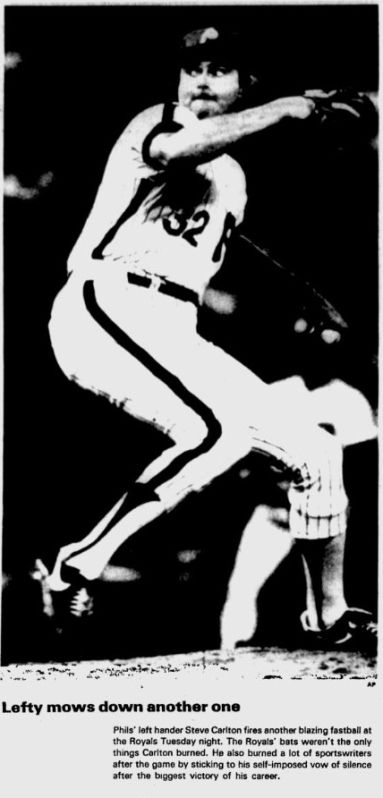
The National League was fairly tightly-packed in 1980. While Philly didn't spend much of the summer in first place, they were never far behind the Pirates or Expos, the two teams who'd gone down to the wire the previous season. Things got a little precarious in early August, when a stretch of poor play (the nadir of which was a four-game sweep in Pittsburgh) put them six games behind their two competitors (who were tied for first) on August 10. It looked like a repeat of last year's race was on the horizon, but the Phillies won eight of their next nine to get back into shape. Around that time the Pirates lost their mojo, and they soon fell out of the race. The Expos stayed in the running though, and they were tied with the Phils with three games left in the season. As if it had been written by Hollywood, the final three-game series matched up Montreal and Philadelphia. Philadelphia won the first game, then clinched the division in the second, when Schmidt's two-run homer in the eleventh sealed the deal.
The NLCS against the Astros was a dramatic affair; four of the five games went into extra innings. Game 1 was a pretty straightforward Phillie win, but the Astros knotted the series in Game 2 with a four-run explosion in the tenth inning. Game 3 was scoreless until the eleventh, when Denny Walling's sacrifice fly gave Houston a 2-1 series edge. With their backs against the wall, the Phillies carried a 3-2 lead into the bottom of the ninth in Game 4 only to see it disappear on Terry Puhl's RBI single. Unfazed, Philadelphia scored two runs in the top of tenth on back-to-back doubles from Greg Luzinski and Manny Trillo to tie the series at two games apiece. The final game featured several late-inning rallies which kept either team from feeling safe, and once again, the matter was settled in extras. The winning blow proved to be Garry Maddox's RBI double in the tenth, giving Philly its first pennant in 30 years.
The Kansas City Royals, led by American League MVP George Brett, were a worthy World Series opponent. Behind rookie emergency starter Bob Walk, the Phillies managed to win Game 1, then rode an eighth-inning rally to victory in Game 2. The Royals won Game 3 on a tenth-inning single, then pulled even with a victory in Game 4. K.C. took a 3-2 lead into the ninth inning of Game 5, but the Phillies scored two runs off relief ace Dan Quisenberry, the go-ahead run coming on a single off the Quiz's glove. McGraw escaped a jam in the bottom of the inning to preserve the win, sending the Series back to the City of Brotherly Love with the hometown team one win away from a long-awaited championship. The Phils controlled Game 6 most of the way; they carried a 4-1 lead into the ninth inning, but they wouldn't escape without some drama. The Royals loaded the bases with one out, and the second out required a great play from first baseman Pete Rose on a foul pop-up. McGraw struck out Willie Wilson to nail down the win.
After 97 seasons without reaching the top of the baseball mountain, the Phillies at long last sat on the summit. The World Series MVP matched the one from the regular season: Mike Schmidt's two homers, seven RBI and 1.176 OPS proved to be the Philadelphia side's standout performance.
Acknowledgements:
Baseball Reference
Baseball Almanac
Google News Archives
Tuesday, June 28, 2011
PTWSW #76: The 1979 Pittsburgh Pirates
Manager: Chuck Tanner
Record: 98-64
Ballpark: Three Rivers Stadium
Owner: John W. Galbreath
GM: Pete Peterson
Coaches: Harvey Haddix, Joe Lonnett, Al Monchak, Bob Skinner
Future Hall of Famers: Bert Blyleven, Willie Stargell
All-Stars: Dave Parker
Team Leaders, Batting
BA: Dave Parker, .310
OBP: Dave Parker, .380
SLG: Willie Stargell, .552
OPS: Dave Parker, .906
2B: Dave Parker, 45
3B: Omar Moreno, 12
HR: Willie Stargell, 32
RBI: Dave Parker, 94
BB: Dave Parker, 67
SB: Omar Moreno, 77 (NL leader)
Team Leaders, Pitching
W: John Candelaria, 14
SO: Bert Blyleven, 172
ERA: Bruce Kison, 3.19
IP: Bert Blyleven, 237.1
CG: John Candelaria, 8
SHO: Jim Bibby, Bruce Kison, 1
K/BB: John Candelaria, 2.47
SV: Kent Tekulve, 31
Tidbits
Oldest Player: Willie Stargell (b. March 6, 1940)
Youngest Player: Don Robinson (b. June 8, 1957)
First to Leave Us: John Milner (d. January 4, 2000)
Last Survivor: Most are still living as of the date of this post.
First in Majors: Willie Stargell (debut September 16, 1962)
Last in Majors: John Candelaria (final game July 7, 1993)
First to Play For the Franchise: Willie Stargell (September 16, 1962)
Last to Play For the Franchise: John Candelaria (July 7, 1993)
Pre-union Team: The 1977 Oakland A's had four: Matt Alexander, Joe Coleman, Dock Ellis and Manny Sanguillen.
Reunion Team: The 1985-86 New York Yankees each had three: Dale Berra, Mike Easler (1986), Omar Moreno (1985) and Ed Whitson.
Accomplishments
Willie Stargell, NL Co-MVP
Dave Parker, NL Outfield Gold Glove
Season Summary
If you've ever wondered which World Series champion was the tightest-knit group of guys, the 1979 Pirates might very well be your answer. Their team slogan was "We Are Family," and the Sister Sledge disco hit of the same name became the team's theme song. The patriarch of the "family" was first baseman Willie Stargell, the club's senior player, affectionately known to his teammates as "Pops." Between his veteran leadership and timely hitting, there was no better role model in the clubhouse.
 As much fun as the season ended up being, things weren't rosy from the start. Less than two weeks into the season the Pirates traded starting shortstop Frank Taveras to the Mets for Tim Foli, a former starting shortstop who'd mostly ridden the bench at that point. Taveras was the better offensive player, but in the early going he'd shown inconsistent effort on defense and a temperamental attitude. In Foli the Pirates got a steadier defender, but there were questions about his bat. Fortunately for Pittsburgh, Foli rewarded them with the best year of his career, setting personal highs in batting and on-base average.
It took the Pirates until the end of May to get to .500, and even then, they were stuck hovering just above the break-even point for the next month. At the end of June they made a trade which bolstered their chances: They acquired third baseman Bill Madlock, a two-time batting champ, from the Giants in a six-player deal. The trade eventually allowed them to move usual third baseman Phil Garner to second, replacing weak-hitting second baseman Rennie Stennett.
On July 8 the Bucs won the second game of a doubleheader in Cincinnati, and it would prove to be the beginning of a stretch where they won 13 of 14. When the first-place Expos started struggling in early August, Pittsburgh jumped ahead of them, and they'd remain there for the next month. Montreal wasn't done yet, though. They went on a tear of their own and by late September they'd retaken first. On September 24, with Montreal leading by half a game, the Pirates and Expos began a four-game showdown at Three Rivers Stadium. The first two games were part of a doubleheader which the two teams split, but the Pirates won the next two to regain the top spot. Going into the last day of the season both teams were tied in the loss column, but the Pirates were ahead by two wins due to the Expos' having lost two games to rainouts. The Pirates won their final game, and fortunately for Pittsburgh, Phillie ace Steve Carlton shut out the Expos, clinching the division for the Steel City.
It was onward to the NLCS. The Pirates' opponent would be the Cincinnati Reds, who'd swept them out of the playoffs four years earlier in Pittsburgh's last postseason appearance. The Reds had home-field advantage, but that meant nothing to the Family; the Pirates pulled out extra-inning wins in the first two games, with Stargell's three-run homer cinching Game 1 and Dave Parker's RBI single deciding Game 2. Back home for Game 3 the pressure was off, and the Pirates rolled to an easy 7-1 victory, wrapping up their first NL pennant in eight years.
The World Series offered another rematch: Eight years earlier the Pirates had faced the Baltimore Orioles in the World Series, and once again, Earl Weaver's birds were the last team standing in the Bucs' way. The favored Orioles got things off to a quick start in Game 1, with five first-inning runs proving to be all that they needed for victory. Pirate veteran Manny Sanguillen's ninth-inning single knotted the Series in Game 2, but Baltimore answered with victories in the next two games, the second of which included an eighth-inning comeback.
On the morning of Game 5, Pirate manager Chuck Tanner received some painful news: his mother had passed away. Despite his personal heartache, Tanner did everything he could to keep his team focused on the game, and the Pirates responded with a 7-1 win. Though they'd kept their hopes alive, Pittsburgh was still in the unenviable position of needing to win the last two games on the road. Game 6 was a pitcher's duel until the seventh inning, when the Pirates finally put two runs on the board, and they'd go on to win 4-0, leaving the entire season's fate riding on one game. The Orioles got an early 1-0 lead in Game 7, but in the sixth inning "Pops" Stargell showed he had one more heroic moment left in him, belting a two-run homer that put his team on top. The Pirates added two more insurance runs in the ninth, and Kent Tekulve retired all three batters he faced in the bottom half of the frame for a Series-clinching save.
The Pirates had beaten the odds: They'd dug their way out of a 3-1 hole, they'd done it against a team that looked better on paper, and they'd won the final two games in enemy territory. It seemed only fitting when the World Series MVP was given to Stargell, who hit three home runs and batted .400 in the seven games. From top to bottom though, the championship had been a family effort.
Acknowledgements:
Baseball Reference
Baseball Almanac
Google News Archives
Record: 98-64
Ballpark: Three Rivers Stadium
Owner: John W. Galbreath
GM: Pete Peterson
Coaches: Harvey Haddix, Joe Lonnett, Al Monchak, Bob Skinner
Future Hall of Famers: Bert Blyleven, Willie Stargell
All-Stars: Dave Parker
Team Leaders, Batting
BA: Dave Parker, .310
OBP: Dave Parker, .380
SLG: Willie Stargell, .552
OPS: Dave Parker, .906
2B: Dave Parker, 45
3B: Omar Moreno, 12
HR: Willie Stargell, 32
RBI: Dave Parker, 94
BB: Dave Parker, 67
SB: Omar Moreno, 77 (NL leader)
Team Leaders, Pitching
W: John Candelaria, 14
SO: Bert Blyleven, 172
ERA: Bruce Kison, 3.19
IP: Bert Blyleven, 237.1
CG: John Candelaria, 8
SHO: Jim Bibby, Bruce Kison, 1
K/BB: John Candelaria, 2.47
SV: Kent Tekulve, 31
Tidbits
Oldest Player: Willie Stargell (b. March 6, 1940)
Youngest Player: Don Robinson (b. June 8, 1957)
First to Leave Us: John Milner (d. January 4, 2000)
Last Survivor: Most are still living as of the date of this post.
First in Majors: Willie Stargell (debut September 16, 1962)
Last in Majors: John Candelaria (final game July 7, 1993)
First to Play For the Franchise: Willie Stargell (September 16, 1962)
Last to Play For the Franchise: John Candelaria (July 7, 1993)
Pre-union Team: The 1977 Oakland A's had four: Matt Alexander, Joe Coleman, Dock Ellis and Manny Sanguillen.
Reunion Team: The 1985-86 New York Yankees each had three: Dale Berra, Mike Easler (1986), Omar Moreno (1985) and Ed Whitson.
Accomplishments
Willie Stargell, NL Co-MVP
Dave Parker, NL Outfield Gold Glove
Season Summary
If you've ever wondered which World Series champion was the tightest-knit group of guys, the 1979 Pirates might very well be your answer. Their team slogan was "We Are Family," and the Sister Sledge disco hit of the same name became the team's theme song. The patriarch of the "family" was first baseman Willie Stargell, the club's senior player, affectionately known to his teammates as "Pops." Between his veteran leadership and timely hitting, there was no better role model in the clubhouse.

It took the Pirates until the end of May to get to .500, and even then, they were stuck hovering just above the break-even point for the next month. At the end of June they made a trade which bolstered their chances: They acquired third baseman Bill Madlock, a two-time batting champ, from the Giants in a six-player deal. The trade eventually allowed them to move usual third baseman Phil Garner to second, replacing weak-hitting second baseman Rennie Stennett.
On July 8 the Bucs won the second game of a doubleheader in Cincinnati, and it would prove to be the beginning of a stretch where they won 13 of 14. When the first-place Expos started struggling in early August, Pittsburgh jumped ahead of them, and they'd remain there for the next month. Montreal wasn't done yet, though. They went on a tear of their own and by late September they'd retaken first. On September 24, with Montreal leading by half a game, the Pirates and Expos began a four-game showdown at Three Rivers Stadium. The first two games were part of a doubleheader which the two teams split, but the Pirates won the next two to regain the top spot. Going into the last day of the season both teams were tied in the loss column, but the Pirates were ahead by two wins due to the Expos' having lost two games to rainouts. The Pirates won their final game, and fortunately for Pittsburgh, Phillie ace Steve Carlton shut out the Expos, clinching the division for the Steel City.
It was onward to the NLCS. The Pirates' opponent would be the Cincinnati Reds, who'd swept them out of the playoffs four years earlier in Pittsburgh's last postseason appearance. The Reds had home-field advantage, but that meant nothing to the Family; the Pirates pulled out extra-inning wins in the first two games, with Stargell's three-run homer cinching Game 1 and Dave Parker's RBI single deciding Game 2. Back home for Game 3 the pressure was off, and the Pirates rolled to an easy 7-1 victory, wrapping up their first NL pennant in eight years.
The World Series offered another rematch: Eight years earlier the Pirates had faced the Baltimore Orioles in the World Series, and once again, Earl Weaver's birds were the last team standing in the Bucs' way. The favored Orioles got things off to a quick start in Game 1, with five first-inning runs proving to be all that they needed for victory. Pirate veteran Manny Sanguillen's ninth-inning single knotted the Series in Game 2, but Baltimore answered with victories in the next two games, the second of which included an eighth-inning comeback.
On the morning of Game 5, Pirate manager Chuck Tanner received some painful news: his mother had passed away. Despite his personal heartache, Tanner did everything he could to keep his team focused on the game, and the Pirates responded with a 7-1 win. Though they'd kept their hopes alive, Pittsburgh was still in the unenviable position of needing to win the last two games on the road. Game 6 was a pitcher's duel until the seventh inning, when the Pirates finally put two runs on the board, and they'd go on to win 4-0, leaving the entire season's fate riding on one game. The Orioles got an early 1-0 lead in Game 7, but in the sixth inning "Pops" Stargell showed he had one more heroic moment left in him, belting a two-run homer that put his team on top. The Pirates added two more insurance runs in the ninth, and Kent Tekulve retired all three batters he faced in the bottom half of the frame for a Series-clinching save.
The Pirates had beaten the odds: They'd dug their way out of a 3-1 hole, they'd done it against a team that looked better on paper, and they'd won the final two games in enemy territory. It seemed only fitting when the World Series MVP was given to Stargell, who hit three home runs and batted .400 in the seven games. From top to bottom though, the championship had been a family effort.
Acknowledgements:
Baseball Reference
Baseball Almanac
Google News Archives
Sunday, March 20, 2011
PTWSW #75: The 1978 New York Yankees
Manager: Billy Martin (1), Dick Howser (2), Bob Lemon (3)
Record: 100-63
Ballpark: Yankee Stadium
Owner: George Steinbrenner
GM: Cedric Tallis
Coaches: Yogi Berra, Art Fowler, Elston Howard, Dick Howser, Clyde King, Gene Michael
Future Hall of Famers: Goose Gossage, Catfish Hunter, Reggie Jackson
All-Stars: Goose Gossage, Ron Guidry, Reggie Jackson, Thurman Munson, Graig Nettles
Team Leaders, Batting
BA: Lou Piniella, .314
OBP: Willie Randolph, .381
SLG: Reggie Jackson, .477
OPS: Reggie Jackson, .834
2B: Lou Piniella, 34
3B: Mickey Rivers, 8
HR: Reggie Jackson, 27
RBI: Reggie Jackson, 97
BB: Willie Randolph, 82
SB: Willie Randolph, 36
Team Leaders, Pitching
W: Ron Guidry, 25 (AL leader)
SO: Ron Guidry, 248
ERA: Ron Guidry, 1.74 (AL leader)
IP: Ron Guidry, 273.2
CG: Ron Guidry, 16
SHO: Ron Guidry, 9 (AL leader)
K/BB: Ron Guidry, 3.44
SV: Goose Gossage, 27 (AL leader)
Tidbits
Oldest Player: Paul Lindblad (b. August 9, 1941)
Youngest Player: Domingo Ramos (b. March 29, 1958)
First to Leave Us: Thurman Munson (d. August 2, 1979)
Last Survivor: Most are still living as of the date of this post.
First in Majors: Lou Piniella (debut September 4, 1964)
Last in Majors: Goose Gossage (final game August 8, 1994)
First to Play For the Franchise: Roy White (September 7, 1965)
Last to Play For the Franchise: Goose Gossage (September 22, 1989)
Pre-union Team: The 1973 Oakland A's had five: Ken Holtzman, Catfish Hunter, Reggie Jackson, Jay Johnstone and Paul Lindblad. Like their ancestors from the '50s, these Yankees built championship rosters with old Athletics.
Reunion Team: The 1981 Oakland Athletics had seven: Brian Doyle, Ed Figueroa, Mike Heath, Cliff Johnson, Mickey Klutts, Jim Spencer and Fred Stanley. If Billy Martin couldn't manage the Yankees, he'd take as many of them with him as he could.
Accomplishments
Ron Guidry, AL Cy Young
Chris Chambliss, AL First Base Gold Glove
Graig Nettles, AL Third Base Gold Glove
Season Summary
After a turbulent but successful season in 1977, the Yankees had acquired a new nickname: "The Bronx Zoo." A circus atmosphere seemed to follow the Yankees wherever they went, and even a World Series title wasn't enough to convince some people that this group wasn't on the verge of imploding. Thanks to George Steinbrenner the Yankees were still the best team money could buy, and they didn't sit idly during the offseason. They signed ace relievers Rawly Eastwick and Goose Gossage, and acquired former All-Stars in pitcher Andy Messersmith and first baseman Jim Spencer. All was not well though; Yank manager Billy Martin didn't want Eastwick or Messersmith, and their acquisitions drove a wedge even further between him and the Boss. It wasn't without good reason that Martin opposed the moves; Messersmith was coming off arm surgery, and Eastwick was superfluous with Gossage and Sparky Lyle already in the pen.
The Yankees started the defense of their title solidly enough. Though they had yet to reach first place, they were only a few games behind the standings-topping Red Sox at the end of May. Martin, in a constant power struggle with upper management, decided to use the unwanted Eastwick sparingly; the pitcher got into only eight games before he was traded to the Phillies in mid-June. Messersmith proved to be as undurable as Martin feared, as he only made it into six games before going on the disabled list at the beginning of July. Meanwhile, the Yankees had begun slumping, and by the middle of July they had a double-digit deficit in the AL East race.
On July 23 Martin publicly criticized Steinbrenner and contentious superstar Reggie Jackson, saying "The two of them deserve each other. One's a born liar, the other's convicted." The latter accusation was a reference to Steinbrenner's conviction for illegal political contributions. The next day, after his statement had been widely circulated, Martin realized he'd gone too far and tearfully resigned, citing the need for physical and mental relief. His successor was the more even-keeled Bob Lemon, who'd recently been demoted from manager to scout by the White Sox and had served on the Yankee coaching staff two years earlier.
 Whether it was Lemon's calming influence or the players finally reverting to the mean, the Yankees got back into the race on Lemon's watch. Over the next month and a half the Yankees went on a 34-13 run to make it into a first-place tie with the Red Sox, and shortly thereafter they took over sole possession of the top spot. Boston wasn't done yet, though. They went 12-2 over their last 14 games to finish the schedule knotted with the Yankees, forcing a one-game tiebreaker at Fenway Park. The Red Sox held a 2-0 lead in the top of the seventh when banjo-hitting Bucky Dent stepped up to the plate with two out and two men on. To everyone's shock, the shortstop delivered a three-run homer, his fifth round-tripper of the year, to turn the momentum in New York's favor. The Yankees would win by a final score of 5-4 to capture their third straight AL East crown.
For the third time in as many years the Yankees faced the Royals in the ALCS, and for the third time in as many years the Yankees emerged victorious. The only difference this time was that New York defeated Kansas City in a mere four games rather than the maximum five. Over in the National League it was the same story: The Los Angeles Dodgers defeated the Philadelphia Phillies in the NLCS for the second straight year. Once again the World Series featured that most common of matchups: Yankees vs. Dodgers. After the first two games it looked like the Dodgers were going to avenge last year's loss, as they won them both. Behind their ace Ron Guidry, the Yankees bounced back with a 5-1 victory in Game 3, and Lou Piniella's 10th-inning RBI single tied the Series in Game 4. The next two games were all Yankees, as they won by margins of ten and five runs. Two feeble-sticked middle infielders, Dent and backup second baseman Brian Doyle, got three hits apiece in both contests, and Dent was even named World Series MVP. The Bronx Zoo Yankees now had back-to-back titles, and the 1978 team became the first World Series champion ever to replace their manager mid-season.
Acknowledgements:
Baseball Reference
Baseball Almanac
Google News Archives
Record: 100-63
Ballpark: Yankee Stadium
Owner: George Steinbrenner
GM: Cedric Tallis
Coaches: Yogi Berra, Art Fowler, Elston Howard, Dick Howser, Clyde King, Gene Michael
Future Hall of Famers: Goose Gossage, Catfish Hunter, Reggie Jackson
All-Stars: Goose Gossage, Ron Guidry, Reggie Jackson, Thurman Munson, Graig Nettles
Team Leaders, Batting
BA: Lou Piniella, .314
OBP: Willie Randolph, .381
SLG: Reggie Jackson, .477
OPS: Reggie Jackson, .834
2B: Lou Piniella, 34
3B: Mickey Rivers, 8
HR: Reggie Jackson, 27
RBI: Reggie Jackson, 97
BB: Willie Randolph, 82
SB: Willie Randolph, 36
Team Leaders, Pitching
W: Ron Guidry, 25 (AL leader)
SO: Ron Guidry, 248
ERA: Ron Guidry, 1.74 (AL leader)
IP: Ron Guidry, 273.2
CG: Ron Guidry, 16
SHO: Ron Guidry, 9 (AL leader)
K/BB: Ron Guidry, 3.44
SV: Goose Gossage, 27 (AL leader)
Tidbits
Oldest Player: Paul Lindblad (b. August 9, 1941)
Youngest Player: Domingo Ramos (b. March 29, 1958)
First to Leave Us: Thurman Munson (d. August 2, 1979)
Last Survivor: Most are still living as of the date of this post.
First in Majors: Lou Piniella (debut September 4, 1964)
Last in Majors: Goose Gossage (final game August 8, 1994)
First to Play For the Franchise: Roy White (September 7, 1965)
Last to Play For the Franchise: Goose Gossage (September 22, 1989)
Pre-union Team: The 1973 Oakland A's had five: Ken Holtzman, Catfish Hunter, Reggie Jackson, Jay Johnstone and Paul Lindblad. Like their ancestors from the '50s, these Yankees built championship rosters with old Athletics.
Reunion Team: The 1981 Oakland Athletics had seven: Brian Doyle, Ed Figueroa, Mike Heath, Cliff Johnson, Mickey Klutts, Jim Spencer and Fred Stanley. If Billy Martin couldn't manage the Yankees, he'd take as many of them with him as he could.
Accomplishments
Ron Guidry, AL Cy Young
Chris Chambliss, AL First Base Gold Glove
Graig Nettles, AL Third Base Gold Glove
Season Summary
After a turbulent but successful season in 1977, the Yankees had acquired a new nickname: "The Bronx Zoo." A circus atmosphere seemed to follow the Yankees wherever they went, and even a World Series title wasn't enough to convince some people that this group wasn't on the verge of imploding. Thanks to George Steinbrenner the Yankees were still the best team money could buy, and they didn't sit idly during the offseason. They signed ace relievers Rawly Eastwick and Goose Gossage, and acquired former All-Stars in pitcher Andy Messersmith and first baseman Jim Spencer. All was not well though; Yank manager Billy Martin didn't want Eastwick or Messersmith, and their acquisitions drove a wedge even further between him and the Boss. It wasn't without good reason that Martin opposed the moves; Messersmith was coming off arm surgery, and Eastwick was superfluous with Gossage and Sparky Lyle already in the pen.
The Yankees started the defense of their title solidly enough. Though they had yet to reach first place, they were only a few games behind the standings-topping Red Sox at the end of May. Martin, in a constant power struggle with upper management, decided to use the unwanted Eastwick sparingly; the pitcher got into only eight games before he was traded to the Phillies in mid-June. Messersmith proved to be as undurable as Martin feared, as he only made it into six games before going on the disabled list at the beginning of July. Meanwhile, the Yankees had begun slumping, and by the middle of July they had a double-digit deficit in the AL East race.
On July 23 Martin publicly criticized Steinbrenner and contentious superstar Reggie Jackson, saying "The two of them deserve each other. One's a born liar, the other's convicted." The latter accusation was a reference to Steinbrenner's conviction for illegal political contributions. The next day, after his statement had been widely circulated, Martin realized he'd gone too far and tearfully resigned, citing the need for physical and mental relief. His successor was the more even-keeled Bob Lemon, who'd recently been demoted from manager to scout by the White Sox and had served on the Yankee coaching staff two years earlier.
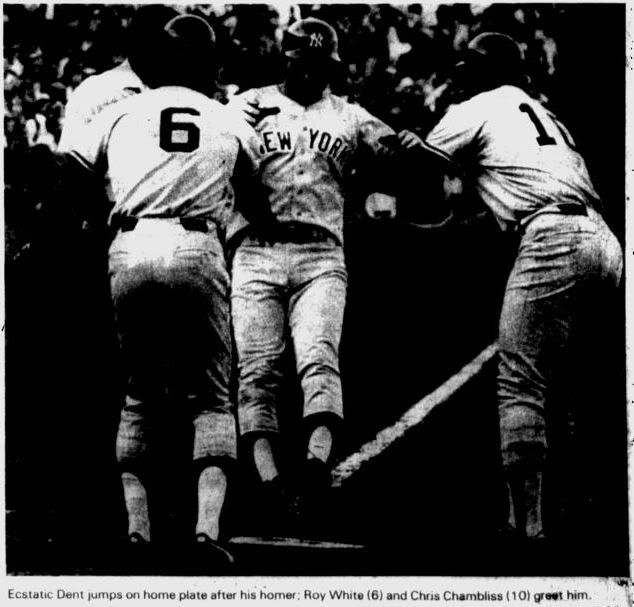 Whether it was Lemon's calming influence or the players finally reverting to the mean, the Yankees got back into the race on Lemon's watch. Over the next month and a half the Yankees went on a 34-13 run to make it into a first-place tie with the Red Sox, and shortly thereafter they took over sole possession of the top spot. Boston wasn't done yet, though. They went 12-2 over their last 14 games to finish the schedule knotted with the Yankees, forcing a one-game tiebreaker at Fenway Park. The Red Sox held a 2-0 lead in the top of the seventh when banjo-hitting Bucky Dent stepped up to the plate with two out and two men on. To everyone's shock, the shortstop delivered a three-run homer, his fifth round-tripper of the year, to turn the momentum in New York's favor. The Yankees would win by a final score of 5-4 to capture their third straight AL East crown.
For the third time in as many years the Yankees faced the Royals in the ALCS, and for the third time in as many years the Yankees emerged victorious. The only difference this time was that New York defeated Kansas City in a mere four games rather than the maximum five. Over in the National League it was the same story: The Los Angeles Dodgers defeated the Philadelphia Phillies in the NLCS for the second straight year. Once again the World Series featured that most common of matchups: Yankees vs. Dodgers. After the first two games it looked like the Dodgers were going to avenge last year's loss, as they won them both. Behind their ace Ron Guidry, the Yankees bounced back with a 5-1 victory in Game 3, and Lou Piniella's 10th-inning RBI single tied the Series in Game 4. The next two games were all Yankees, as they won by margins of ten and five runs. Two feeble-sticked middle infielders, Dent and backup second baseman Brian Doyle, got three hits apiece in both contests, and Dent was even named World Series MVP. The Bronx Zoo Yankees now had back-to-back titles, and the 1978 team became the first World Series champion ever to replace their manager mid-season.
Acknowledgements:
Baseball Reference
Baseball Almanac
Google News Archives
Thursday, January 20, 2011
PTWSW #74: The 1977 New York Yankees
Manager: Billy Martin
Record: 100-62
Ballpark: Yankee Stadium
Owner: George Steinbrenner
GM: Gabe Paul
Coaches: Yogi Berra, Cloyd Boyer, Bobby Cox, Art Fowler, Elston Howard, Dick Howser
Future Hall of Famers: Catfish Hunter, Reggie Jackson
All-Stars: Reggie Jackson, Sparky Lyle, Thurman Munson, Graig Nettles, Willie Randolph
Team Leaders, Batting
BA: Mickey Rivers, .326
OBP: Reggie Jackson, 375
SLG: Reggie Jackson, .550
OPS: Reggie Jackson, .925
2B: Reggie Jackson, 39
3B: Willie Randolph, 11
HR: Graig Nettles, 37
RBI: Reggie Jackson, 110
BB: Roy White, 75
SB: Mickey Rivers, 22
Team Leaders, Pitching
W: Ed Figueroa, Ron Guidry, 16
SO: Ron Guidry, 176
ERA: Ron Guidry, 2.82
IP: Ed Figueroa, 239.1
CG: Mike Torrez, 15
SHO: Ron Guidry, 5
K/BB: Ron Guidry, 2.71
SV: Sparky Lyle, 26
Tidbits
Oldest Player: Elrod Hendricks (b. December 22, 1940)
Youngest Player: Gil Patterson (b. September 5, 1955)
First to Leave Us: Thurman Munson (d. August 2, 1979). The Yankee family received a shock just two years later when their team captain, a licensed pilot, met an untimely end by crashing his private jet.
Last Survivor: Most are still living as of the date of this post.
First in Majors: Jimmy Wynn (debut July 10, 1963)
Last in Majors: Dave Bergman and Willie Randolph both played their final games on October 4, 1992.
First to Play For the Franchise: Roy White (September 7, 1965)
Last to Play For the Franchise: Willie Randolph played his last game for the Yankees on September 30, 1988, three days after Ron Guidry played his.
Pre-union Team: The 1972 Indians (Chris Chambliss, Graig Nettles, Fred Stanley, Dick Tidrow) and 1976 Orioles (Paul Blair, Elrod Hendricks, Ken Holtzman, Reggie Jackson) with four each.
Reunion Team: The 1979-80 Rangers (Ken Clay (1980), Dock Ellis (1979), Ed Figueroa (1980), Sparky Lyle, Larry McCall (1979), Mickey Rivers) and 1981 Athletics (Ed Figueroa, Cliff Johnson, Mickey Klutts, Fred Stanley) with four each.
Other: Yankee Stadium hosted the All-Star Game that year, the third time the World Series winner was the All-Star host.
Accomplishments
Sparky Lyle, AL Cy Young
Graig Nettles, AL Third Base Gold Glove
Season Summary
After the Reds romped over the Yankees in the 1976 World Series, owner George Steinbrenner vowed his team would be back stronger next year. He made good on his promise; first he signed Don Gullett away from the Reds to solidify the top of their rotation, then he landed Reggie Jackson from the Orioles to play right field and strengthen the heart of their lineup. Veteran outfielders Jimmy Wynn and Paul Blair were brought on as well, and two days before Opening Day the Yanks traded surplus outfielder Oscar Gamble to the White Sox for shortstop Bucky Dent. With a well-balanced roster and their talent level clearly upgraded, the Yankees began the season heavily favored to repeat as AL Champions. The question remained though, how well combative manager Billy Martin, the strong-willed Steinbrenner and this collection of large egos would be able to coexist.
As it turned out, the lack of chemistry wasn't enough to prevent the Yankees from winning, though they didn't run away with the pennant as many thought they could've. They spent less than half the season in first place, never with a sizable lead, and it was only a late hot streak that allowed them to make the playoffs. True to expectations, the clubhouse was a tumultuous environment. Catcher Thurman Munson was officially the team captain, but his star was often overshadowed by the charismatic and controversial Reggie Jackson. In May, Sport magazine published an interview where Jackson referred to himself as "the straw that stirs the drink" (speaking metaphorically about the Yankees) and said that Munson "could only stir it bad," a quote that did little to endear him to his new teammate.
 Billy Martin's job security was called into question throughout the year due to strained relations with the front office and the sense that the team was underachieving, but he always managed to avoid the axe. The hard-nosed Martin was constantly at odds with the egotistical Jackson, and their feuding boiled over on June 18, when Martin pulled Jackson in the sixth inning of a loss to Boston for a lack of effort, prompting a dugout brawl. It wasn't until the last two months that the Yankees finally started playing to their highest capabilities. On August 6 they were 59-49, in third place and five games out of first; they finished the season on a 41-13 tear, pulling them ahead of the Red Sox and Orioles for another division title.
The ALCS rematched the Yankees with the Kansas City Royals, who they'd beaten en route to the pennant the year before. In 1976 the Yankees had won in five games when Chris Chambliss hit a walkoff blast; for the second year in a row, it came down to the ninth inning of Game 5. In the top half, with the Royals holding a one-run lead, the Yankees tallied three runs, taking the lead on Willie Randolph's sacrifice fly. Sparky Lyle followed by pitching a scoreless bottom half, punching the Yankees' tickets back to the World Series.
The Fall Classic presented a modern twist on the 1950's New York baseball scene, as what was once a perennial battle of the boroughs became a study in coastal contrasts. The National League Champion was the Los Angeles Dodgers, now representing the glamor of Hollywood rather than blue-collar family atmosphere of Brooklyn. As frequently happened two decades earlier, the Dodgers put up a good fight, but didn't have enough to knock off the men in pinstripes. After the Yankees won Game 1 on Paul Blair's twelfth-inning RBI single, the two teams split the next four games, setting up the most memorable performance of the Series.
Game 6 itself wasn't particularly close, but that night Reggie Jackson earned the nickname for which he'll always be remembered: "Mr. October." In three official at-bats against three different pitchers, Jackson sent the first offering into the seats, making him only the second player in history to notch three homers in a World Series game. The Yankees won it 8-4 to clinch their first title in 15 years, with Jackson's heroics earning him the MVP. In spite of all the drama behind (and in) the scenes, the Bombers had come together as a championship ballclub.
Acknowledgements:
Baseball Reference
Baseball Almanac
Google News Archives
Record: 100-62
Ballpark: Yankee Stadium
Owner: George Steinbrenner
GM: Gabe Paul
Coaches: Yogi Berra, Cloyd Boyer, Bobby Cox, Art Fowler, Elston Howard, Dick Howser
Future Hall of Famers: Catfish Hunter, Reggie Jackson
All-Stars: Reggie Jackson, Sparky Lyle, Thurman Munson, Graig Nettles, Willie Randolph
Team Leaders, Batting
BA: Mickey Rivers, .326
OBP: Reggie Jackson, 375
SLG: Reggie Jackson, .550
OPS: Reggie Jackson, .925
2B: Reggie Jackson, 39
3B: Willie Randolph, 11
HR: Graig Nettles, 37
RBI: Reggie Jackson, 110
BB: Roy White, 75
SB: Mickey Rivers, 22
Team Leaders, Pitching
W: Ed Figueroa, Ron Guidry, 16
SO: Ron Guidry, 176
ERA: Ron Guidry, 2.82
IP: Ed Figueroa, 239.1
CG: Mike Torrez, 15
SHO: Ron Guidry, 5
K/BB: Ron Guidry, 2.71
SV: Sparky Lyle, 26
Tidbits
Oldest Player: Elrod Hendricks (b. December 22, 1940)
Youngest Player: Gil Patterson (b. September 5, 1955)
First to Leave Us: Thurman Munson (d. August 2, 1979). The Yankee family received a shock just two years later when their team captain, a licensed pilot, met an untimely end by crashing his private jet.
Last Survivor: Most are still living as of the date of this post.
First in Majors: Jimmy Wynn (debut July 10, 1963)
Last in Majors: Dave Bergman and Willie Randolph both played their final games on October 4, 1992.
First to Play For the Franchise: Roy White (September 7, 1965)
Last to Play For the Franchise: Willie Randolph played his last game for the Yankees on September 30, 1988, three days after Ron Guidry played his.
Pre-union Team: The 1972 Indians (Chris Chambliss, Graig Nettles, Fred Stanley, Dick Tidrow) and 1976 Orioles (Paul Blair, Elrod Hendricks, Ken Holtzman, Reggie Jackson) with four each.
Reunion Team: The 1979-80 Rangers (Ken Clay (1980), Dock Ellis (1979), Ed Figueroa (1980), Sparky Lyle, Larry McCall (1979), Mickey Rivers) and 1981 Athletics (Ed Figueroa, Cliff Johnson, Mickey Klutts, Fred Stanley) with four each.
Other: Yankee Stadium hosted the All-Star Game that year, the third time the World Series winner was the All-Star host.
Accomplishments
Sparky Lyle, AL Cy Young
Graig Nettles, AL Third Base Gold Glove
Season Summary
After the Reds romped over the Yankees in the 1976 World Series, owner George Steinbrenner vowed his team would be back stronger next year. He made good on his promise; first he signed Don Gullett away from the Reds to solidify the top of their rotation, then he landed Reggie Jackson from the Orioles to play right field and strengthen the heart of their lineup. Veteran outfielders Jimmy Wynn and Paul Blair were brought on as well, and two days before Opening Day the Yanks traded surplus outfielder Oscar Gamble to the White Sox for shortstop Bucky Dent. With a well-balanced roster and their talent level clearly upgraded, the Yankees began the season heavily favored to repeat as AL Champions. The question remained though, how well combative manager Billy Martin, the strong-willed Steinbrenner and this collection of large egos would be able to coexist.
As it turned out, the lack of chemistry wasn't enough to prevent the Yankees from winning, though they didn't run away with the pennant as many thought they could've. They spent less than half the season in first place, never with a sizable lead, and it was only a late hot streak that allowed them to make the playoffs. True to expectations, the clubhouse was a tumultuous environment. Catcher Thurman Munson was officially the team captain, but his star was often overshadowed by the charismatic and controversial Reggie Jackson. In May, Sport magazine published an interview where Jackson referred to himself as "the straw that stirs the drink" (speaking metaphorically about the Yankees) and said that Munson "could only stir it bad," a quote that did little to endear him to his new teammate.

The ALCS rematched the Yankees with the Kansas City Royals, who they'd beaten en route to the pennant the year before. In 1976 the Yankees had won in five games when Chris Chambliss hit a walkoff blast; for the second year in a row, it came down to the ninth inning of Game 5. In the top half, with the Royals holding a one-run lead, the Yankees tallied three runs, taking the lead on Willie Randolph's sacrifice fly. Sparky Lyle followed by pitching a scoreless bottom half, punching the Yankees' tickets back to the World Series.
The Fall Classic presented a modern twist on the 1950's New York baseball scene, as what was once a perennial battle of the boroughs became a study in coastal contrasts. The National League Champion was the Los Angeles Dodgers, now representing the glamor of Hollywood rather than blue-collar family atmosphere of Brooklyn. As frequently happened two decades earlier, the Dodgers put up a good fight, but didn't have enough to knock off the men in pinstripes. After the Yankees won Game 1 on Paul Blair's twelfth-inning RBI single, the two teams split the next four games, setting up the most memorable performance of the Series.
Game 6 itself wasn't particularly close, but that night Reggie Jackson earned the nickname for which he'll always be remembered: "Mr. October." In three official at-bats against three different pitchers, Jackson sent the first offering into the seats, making him only the second player in history to notch three homers in a World Series game. The Yankees won it 8-4 to clinch their first title in 15 years, with Jackson's heroics earning him the MVP. In spite of all the drama behind (and in) the scenes, the Bombers had come together as a championship ballclub.
Acknowledgements:
Baseball Reference
Baseball Almanac
Google News Archives
Wednesday, December 22, 2010
PTWSW #73: The 1976 Cincinnati Reds
Manager: Sparky Anderson
Record: 102-60
Ballpark: Riverfront Stadium
Owner: Louis Nippert
GM: Bob Howsam
Coaches: Ted Kluszewski, Russ Nixon, George Scherger, Larry Shepard
Future Hall of Famers: Johnny Bench, Joe Morgan, Tony Perez
All-Stars: Johnny Bench, Dave Concepcion, George Foster, Ken Griffey, Joe Morgan, Tony Perez, Pete Rose
Team Leaders, Batting
BA: Ken Griffey, .336
OBP: Joe Morgan, .444 (NL leader)
SLG: Joe Morgan, .576 (NL leader)
OPS: Joe Morgan, 1.020 (NL leader)
2B: Pete Rose, 42 (NL leader)
3B: Cesar Geronimo, 11
HR: George Foster, 29
RBI: George Foster, 121 (NL leader)
BB: Joe Morgan, 114
SB: Joe Morgan, 60
Team Leaders, Pitching
W: Gary Nolan, 15
SO: Pat Zachry, 143
ERA: Pat Zachry, 2.74
IP: Gary Nolan, 239.1
CG: Fred Norman, 8
SHO: Fred Norman, 3
K/BB: Gary Nolan, 4.19 (NL leader)
SV: Rawly Eastwick, 26 (NL leader)
Tidbits
Oldest Player: Pete Rose (b. April 14, 1941)
Youngest Player: Manny Sarmiento (b. February 2, 1956)
First to Leave Us: Pedro Borbon (d. June 4, 2012). Incidentally, this team holds the record among World Series Champions for the longest gap between the day they won the Series and the first death of a player, at 35 years, 7 months and 14 days (second-best is the 1952 New York Yankees).
Last Survivor: Most are still living as of the date of this post.
First in Majors: Bob Bailey (debut September 14, 1962)
Last in Majors: Ken Griffey (final game May 31, 1991)
First to Play For the Franchise: Pete Rose (April 8, 1963)
Last to Play For the Franchise: Ken Griffey (August 17, 1990)
Pre-union Team: The 1969-71 Astros had three: Jack Billingham, Cesar Geronimo and Joe Morgan.
Reunion Team: The 1977 Expos (Santo Alcala, Will McEnaney, Tony Perez), 1977-82 Mets (Doug Flynn (1977-81), George Foster (1982), Joel Youngblood, Pat Zachry), 1983 Phillies (Joe Morgan, Tony Perez, Pete Rose) and 1984 Expos (Dan Driessen, Doug Flynn, Pete Rose) each had three.
Accomplishments
Joe Morgan, NL MVP
Pat Zachry, NL Co-Rookie of the Year
Johnny Bench, NL Catcher Gold Glove
Joe Morgan, NL Second Base Gold Glove
Dave Concepcion, NL Shortstop Gold Glove
Cesar Geronimo, NL Outfield Gold Glove
Season Summary
After finally winning the World Series the previous year, the Big Red Machine continued to roll. As great as the Reds' offense had been in 1975, in 1976 it was even better. Cincinnati led the NL in everything: runs, hits, doubles, triples, homers, stolen bases, walks, all the slash stats, and even strikeouts. Their pitching and defense fell to middle-of-the-pack, which meant they allowed more runs, but their lineup was so dominant that they still managed to win 102 games and finish ten games ahead in their division. For the second year in a row, Joe Morgan was named National League MVP, leading the team offensively and playing a solid second base.
 In the postseason the Reds were flat-out unstoppable. For their first act, they swept the Philadelphia Phillies, winners of 101 games, in the NLCS. They won the first two games easily, and just when the Phillies looked to make it a series the Reds snatched away another victory. In Game 3 Philly held a 6-4 lead going into the bottom of the ninth, but Cincy led off the inning with back-to-back homers from George Foster and Johnny Bench. The Reds then loaded the bases for Ken Griffey, whose chopper deflected off first baseman Bobby Tolan's glove, scoring Dave Concepcion with the winning run. For the second straight season the Reds were National League Champions.
The Reds' World Series opponent was the New York Yankees, who were playing in the Fall Classic for the first time in 12 years. Unlike their archrivals the year before, the Yankees didn't put up much of a fight. After an easy Red win in Game 1, Game 2 was the only one where New York even came close. With two out and the bases empty in the bottom of the ninth, the game was tied. Griffey hit a grounder that resulted in a throwing error on Yankee shortstop Fred Stanley, and suddenly the winning run was on second. After an intentional walk to Morgan, Tony Perez struck the walkoff blow, singling to left and scoring Griffey. The Series shifted to Yankee Stadium, but even at home the Bombers looked helpless against the Reds; Cincinnati won the final two games by a combined score of 13-4, completing a sweep of the entire postseason and winning their second title in as many years.
Cincinnati's team OPS over the four games was an incredible .887, and their ERA was a dominant 2.00. For his two homers, six RBI and .533 batting average, Johnny Bench was named World Series MVP.
Acknowledgements:
Baseball Reference
Baseball Almanac
Google News Archives
Record: 102-60
Ballpark: Riverfront Stadium
Owner: Louis Nippert
GM: Bob Howsam
Coaches: Ted Kluszewski, Russ Nixon, George Scherger, Larry Shepard
Future Hall of Famers: Johnny Bench, Joe Morgan, Tony Perez
All-Stars: Johnny Bench, Dave Concepcion, George Foster, Ken Griffey, Joe Morgan, Tony Perez, Pete Rose
Team Leaders, Batting
BA: Ken Griffey, .336
OBP: Joe Morgan, .444 (NL leader)
SLG: Joe Morgan, .576 (NL leader)
OPS: Joe Morgan, 1.020 (NL leader)
2B: Pete Rose, 42 (NL leader)
3B: Cesar Geronimo, 11
HR: George Foster, 29
RBI: George Foster, 121 (NL leader)
BB: Joe Morgan, 114
SB: Joe Morgan, 60
Team Leaders, Pitching
W: Gary Nolan, 15
SO: Pat Zachry, 143
ERA: Pat Zachry, 2.74
IP: Gary Nolan, 239.1
CG: Fred Norman, 8
SHO: Fred Norman, 3
K/BB: Gary Nolan, 4.19 (NL leader)
SV: Rawly Eastwick, 26 (NL leader)
Tidbits
Oldest Player: Pete Rose (b. April 14, 1941)
Youngest Player: Manny Sarmiento (b. February 2, 1956)
First to Leave Us: Pedro Borbon (d. June 4, 2012). Incidentally, this team holds the record among World Series Champions for the longest gap between the day they won the Series and the first death of a player, at 35 years, 7 months and 14 days (second-best is the 1952 New York Yankees).
Last Survivor: Most are still living as of the date of this post.
First in Majors: Bob Bailey (debut September 14, 1962)
Last in Majors: Ken Griffey (final game May 31, 1991)
First to Play For the Franchise: Pete Rose (April 8, 1963)
Last to Play For the Franchise: Ken Griffey (August 17, 1990)
Pre-union Team: The 1969-71 Astros had three: Jack Billingham, Cesar Geronimo and Joe Morgan.
Reunion Team: The 1977 Expos (Santo Alcala, Will McEnaney, Tony Perez), 1977-82 Mets (Doug Flynn (1977-81), George Foster (1982), Joel Youngblood, Pat Zachry), 1983 Phillies (Joe Morgan, Tony Perez, Pete Rose) and 1984 Expos (Dan Driessen, Doug Flynn, Pete Rose) each had three.
Accomplishments
Joe Morgan, NL MVP
Pat Zachry, NL Co-Rookie of the Year
Johnny Bench, NL Catcher Gold Glove
Joe Morgan, NL Second Base Gold Glove
Dave Concepcion, NL Shortstop Gold Glove
Cesar Geronimo, NL Outfield Gold Glove
Season Summary
After finally winning the World Series the previous year, the Big Red Machine continued to roll. As great as the Reds' offense had been in 1975, in 1976 it was even better. Cincinnati led the NL in everything: runs, hits, doubles, triples, homers, stolen bases, walks, all the slash stats, and even strikeouts. Their pitching and defense fell to middle-of-the-pack, which meant they allowed more runs, but their lineup was so dominant that they still managed to win 102 games and finish ten games ahead in their division. For the second year in a row, Joe Morgan was named National League MVP, leading the team offensively and playing a solid second base.
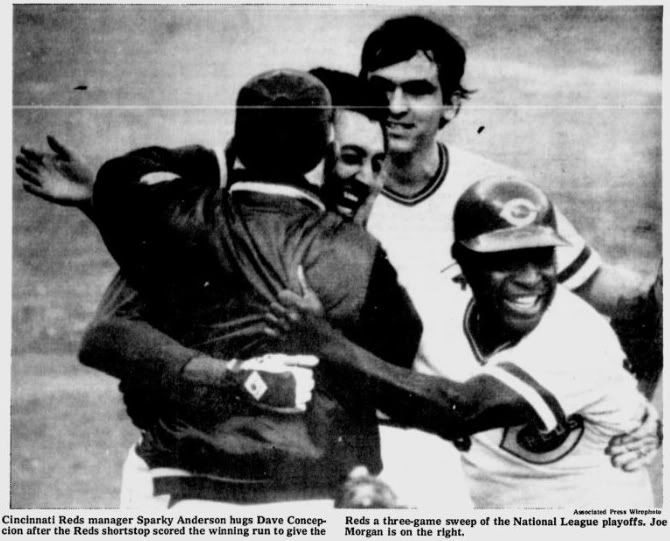
The Reds' World Series opponent was the New York Yankees, who were playing in the Fall Classic for the first time in 12 years. Unlike their archrivals the year before, the Yankees didn't put up much of a fight. After an easy Red win in Game 1, Game 2 was the only one where New York even came close. With two out and the bases empty in the bottom of the ninth, the game was tied. Griffey hit a grounder that resulted in a throwing error on Yankee shortstop Fred Stanley, and suddenly the winning run was on second. After an intentional walk to Morgan, Tony Perez struck the walkoff blow, singling to left and scoring Griffey. The Series shifted to Yankee Stadium, but even at home the Bombers looked helpless against the Reds; Cincinnati won the final two games by a combined score of 13-4, completing a sweep of the entire postseason and winning their second title in as many years.
Cincinnati's team OPS over the four games was an incredible .887, and their ERA was a dominant 2.00. For his two homers, six RBI and .533 batting average, Johnny Bench was named World Series MVP.
Acknowledgements:
Baseball Reference
Baseball Almanac
Google News Archives
Tuesday, December 21, 2010
PTWSW #72: The 1975 Cincinnati Reds
Manager: Sparky Anderson
Record: 108-54
Ballpark: Riverfront Stadium
Owner: Louis Nippert
GM: Bob Howsam
Coaches: Alex Grammas, Ted Kluszewski, George Scherger, Larry Shepard
Future Hall of Famers: Johnny Bench, Joe Morgan, Tony Perez
All-Stars: Johnny Bench, Dave Concepcion, Joe Morgan, Tony Perez, Pete Rose
Team Leaders, Batting
BA: Joe Morgan, .327
OBP: Joe Morgan, .466 (NL leader)
SLG: Johnny Bench, .519
OPS: Joe Morgan, .974 (NL leader)
2B: Pete Rose, 47 (NL leader)
3B: Ken Griffey, 9
HR: Johnny Bench, 28
RBI: Johnny Bench, 110
BB: Joe Morgan, 132 (NL leader)
SB: Joe Morgan, 67
Team Leaders, Pitching
W: Jack Billingham, Don Gullett, Gary Nolan, 15
SO: Fred Norman, 119
ERA: Gary Nolan, 3.16
IP: Gary Nolan, 210.2
CG: Don Gullett, 8
SHO: Don Gullett, 3
K/BB: Gary Nolan, 2.55
SV: Rawly Eastwick, 22
Tidbits
Oldest Player: Pete Rose (b. April 14, 1941)
Youngest Player: Don Werner (b. March 8, 1953)
First to Leave Us: Clay Kirby (d. October 11, 1991)
Last Survivor: Most are still living as of the date of this post.
First in Majors: Fred Norman (debut September 21, 1962)
Last in Majors: Ken Griffey (final game May 31, 1991)
First to Play For the Franchise: Pete Rose (April 8, 1963)
Last to Play For the Franchise: Ken Griffey (August 17, 1990). The Reds won the World Series that year, but Griffey never got a champagne shower, as he was released down the stretch. The season was a memorable one for Griffey though; he joined the Mariners for the final month, and with his son Ken Jr. became the first father-son duo to hit back-to-back homers.
Pre-union Team: The 1969-71 Astros had three: Jack Billingham, Cesar Geronimo and Joe Morgan. This trio was acquired by the Reds in one blockbuster trade before the 1972 season.
Reunion Team: The 1979 Phillies (Rawly Eastwick, Pete Rose, John Vukovich), 1983 Phillies (Joe Morgan, Tony Perez, Pete Rose) and 1984 Expos (Dan Driessen, Doug Flynn, Pete Rose) each had three.
Accomplishments
Joe Morgan, NL MVP
Johnny Bench, NL Catcher Gold Glove
Joe Morgan, NL Second Base Gold Glove
Dave Concepcion, NL Shortstop Gold Glove
Cesar Geronimo, NL Outfield Gold Glove
Season Summary
 Since their pennant-winning season in 1970 the Reds had been widely known as the "Big Red Machine" for their offensive firepower. That machine, however, had always sputtered to a stop just short of a World Series title. In 1975 the Machine had its finest season ever, winning 108 games behind a lineup that scored 105 more runs than the next-best team. They led the NL in stolen bases (as well as success rate), walks and on-base percentage, and were second in batting average and third in homers. They also had the run preventive abilities to complement their offense; their defense was second in DER and TotalZone, and their staff of mostly finesse pitchers posted the league's third-best ERA+.
The 1975 season didn't exactly get off to a rip-roaring start. On May 2 the Reds were 12-12, and third baseman John Vukovich, named starter over 1974's defensively-challenged Dan Driessen, was a gaping hole in their batting order. The solution came through a radical change: left fielder Pete Rose would move to third, a position he'd only briefly played nine years earlier, and slugger George Foster would take over in left. There were some initial struggles, but once the players settled into their new roles the team became virtually unstoppable. On May 16 the Reds were 18-19; their record for the remainder of the season would be 90-35. They took over first place in early June, and a month later they'd built up a double-digit lead. They left the second-place Dodgers in their dust, winning the NL West by an astounding 20 games.
The Reds made quick work of the Pirates in the NLCS, sweeping them in three straight to meet the Boston Red Sox in the World Series. Boston wasn't nearly the powerhouse Cincinnati was, but they wouldn't go down without a fight. Red Sox ace Luis Tiant pitched a shutout in Game 1, and it took a ninth-inning rally for Cincinnati to win Game 2. The Reds won Game 3 on Joe Morgan's tenth-inning single (after a controversial non-interference call on pinch-hitter Ed Armbrister), but Tiant pitched the BoSox to another victory in Game 4. The Reds bounced back to win Game 5, leaving them one win away headed back to Boston. Game 6 was a see-saw affair. The Red Sox went up 3-0 early, only to have the Reds storm back for a 6-3 lead. With two out in the eighth, Boston pinch-hitter Bernie Carbo tied it with a three-run homer, and the Red Sox would win in the twelfth on a walkoff blast from Carlton Fisk.
The Red Sox took another early 3-0 lead in Game 7, but those runs were the last they'd score for the season. The Reds chipped away for the next few innings before finally taking the lead in the ninth on another Joe Morgan single. Boston went down in order in the bottom half, and for the first time since 1940 (before any of their players were born) the Cincinnati Reds were World Series Champions. After years of coming up short, the famous "Big Red Machine" had finally reached the pinnacle. Pete Rose, the man whose position change had sparked their dominant run, was named World Series MVP.
Acknowledgements:
Baseball Reference
Baseball Almanac
Google News Archives
Record: 108-54
Ballpark: Riverfront Stadium
Owner: Louis Nippert
GM: Bob Howsam
Coaches: Alex Grammas, Ted Kluszewski, George Scherger, Larry Shepard
Future Hall of Famers: Johnny Bench, Joe Morgan, Tony Perez
All-Stars: Johnny Bench, Dave Concepcion, Joe Morgan, Tony Perez, Pete Rose
Team Leaders, Batting
BA: Joe Morgan, .327
OBP: Joe Morgan, .466 (NL leader)
SLG: Johnny Bench, .519
OPS: Joe Morgan, .974 (NL leader)
2B: Pete Rose, 47 (NL leader)
3B: Ken Griffey, 9
HR: Johnny Bench, 28
RBI: Johnny Bench, 110
BB: Joe Morgan, 132 (NL leader)
SB: Joe Morgan, 67
Team Leaders, Pitching
W: Jack Billingham, Don Gullett, Gary Nolan, 15
SO: Fred Norman, 119
ERA: Gary Nolan, 3.16
IP: Gary Nolan, 210.2
CG: Don Gullett, 8
SHO: Don Gullett, 3
K/BB: Gary Nolan, 2.55
SV: Rawly Eastwick, 22
Tidbits
Oldest Player: Pete Rose (b. April 14, 1941)
Youngest Player: Don Werner (b. March 8, 1953)
First to Leave Us: Clay Kirby (d. October 11, 1991)
Last Survivor: Most are still living as of the date of this post.
First in Majors: Fred Norman (debut September 21, 1962)
Last in Majors: Ken Griffey (final game May 31, 1991)
First to Play For the Franchise: Pete Rose (April 8, 1963)
Last to Play For the Franchise: Ken Griffey (August 17, 1990). The Reds won the World Series that year, but Griffey never got a champagne shower, as he was released down the stretch. The season was a memorable one for Griffey though; he joined the Mariners for the final month, and with his son Ken Jr. became the first father-son duo to hit back-to-back homers.
Pre-union Team: The 1969-71 Astros had three: Jack Billingham, Cesar Geronimo and Joe Morgan. This trio was acquired by the Reds in one blockbuster trade before the 1972 season.
Reunion Team: The 1979 Phillies (Rawly Eastwick, Pete Rose, John Vukovich), 1983 Phillies (Joe Morgan, Tony Perez, Pete Rose) and 1984 Expos (Dan Driessen, Doug Flynn, Pete Rose) each had three.
Accomplishments
Joe Morgan, NL MVP
Johnny Bench, NL Catcher Gold Glove
Joe Morgan, NL Second Base Gold Glove
Dave Concepcion, NL Shortstop Gold Glove
Cesar Geronimo, NL Outfield Gold Glove
Season Summary
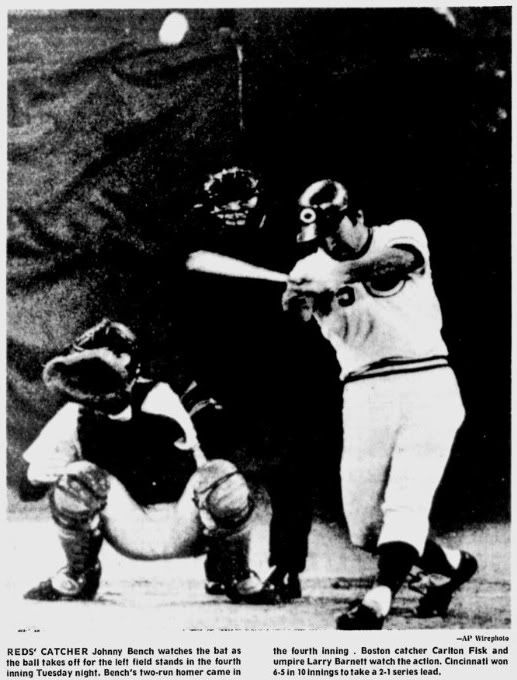 Since their pennant-winning season in 1970 the Reds had been widely known as the "Big Red Machine" for their offensive firepower. That machine, however, had always sputtered to a stop just short of a World Series title. In 1975 the Machine had its finest season ever, winning 108 games behind a lineup that scored 105 more runs than the next-best team. They led the NL in stolen bases (as well as success rate), walks and on-base percentage, and were second in batting average and third in homers. They also had the run preventive abilities to complement their offense; their defense was second in DER and TotalZone, and their staff of mostly finesse pitchers posted the league's third-best ERA+.
The 1975 season didn't exactly get off to a rip-roaring start. On May 2 the Reds were 12-12, and third baseman John Vukovich, named starter over 1974's defensively-challenged Dan Driessen, was a gaping hole in their batting order. The solution came through a radical change: left fielder Pete Rose would move to third, a position he'd only briefly played nine years earlier, and slugger George Foster would take over in left. There were some initial struggles, but once the players settled into their new roles the team became virtually unstoppable. On May 16 the Reds were 18-19; their record for the remainder of the season would be 90-35. They took over first place in early June, and a month later they'd built up a double-digit lead. They left the second-place Dodgers in their dust, winning the NL West by an astounding 20 games.
The Reds made quick work of the Pirates in the NLCS, sweeping them in three straight to meet the Boston Red Sox in the World Series. Boston wasn't nearly the powerhouse Cincinnati was, but they wouldn't go down without a fight. Red Sox ace Luis Tiant pitched a shutout in Game 1, and it took a ninth-inning rally for Cincinnati to win Game 2. The Reds won Game 3 on Joe Morgan's tenth-inning single (after a controversial non-interference call on pinch-hitter Ed Armbrister), but Tiant pitched the BoSox to another victory in Game 4. The Reds bounced back to win Game 5, leaving them one win away headed back to Boston. Game 6 was a see-saw affair. The Red Sox went up 3-0 early, only to have the Reds storm back for a 6-3 lead. With two out in the eighth, Boston pinch-hitter Bernie Carbo tied it with a three-run homer, and the Red Sox would win in the twelfth on a walkoff blast from Carlton Fisk.
The Red Sox took another early 3-0 lead in Game 7, but those runs were the last they'd score for the season. The Reds chipped away for the next few innings before finally taking the lead in the ninth on another Joe Morgan single. Boston went down in order in the bottom half, and for the first time since 1940 (before any of their players were born) the Cincinnati Reds were World Series Champions. After years of coming up short, the famous "Big Red Machine" had finally reached the pinnacle. Pete Rose, the man whose position change had sparked their dominant run, was named World Series MVP.
Acknowledgements:
Baseball Reference
Baseball Almanac
Google News Archives
Saturday, December 4, 2010
PTWSW #71: The 1974 Oakland A's
Manager: Alvin Dark
Record: 90-72
Ballpark: Oakland-Alameda County Coliseum
Owner: Charles O. Finley
Coaches: Jerry Adair, Bobby Hofman, Wes Stock, Bobby Winkles
Future Hall of Famers: Rollie Fingers, Catfish Hunter, Reggie Jackson
All-Stars: Sal Bando, Bert Campaneris, Rollie Fingers, Catfish Hunter, Reggie Jackson, Joe Rudi
Team Leaders, Batting
BA: Joe Rudi, .293
OBP: Reggie Jackson, .391
SLG: Reggie Jackson, .514
OPS: Reggie Jackson, .905
2B: Joe Rudi, 39
3B: Bert Campaneris, 8
HR: Reggie Jackson, 29
RBI: Sal Bando, 103
BB: Gene Tenace, 110
SB: Bill North, 54
Team Leaders, Pitching
W: Catfish Hunter, 25
SO: Vida Blue, 174
ERA: Catfish Hunter, 2.49
IP: Catfish Hunter, 318.1
CG: Catfish Hunter, 23
SHO: Catfish Hunter, 6
K/BB: Catfish Hunter, 3.11
SV: Rollie Fingers, 18
Tidbits
Oldest Player: Vic Davalillo (b. July 31, 1936)
Youngest Player: Claudell Washington (b. August 31, 1954)
First to Leave Us: Deron Johnson (d. April 23, 1992)
Last Survivor: Most are still living as of the date of this post.
First in Majors: Deron Johnson (debut September 20, 1960)
Last in Majors: Claudell Washington (final game June 18, 1990)
First to Play For the Franchise: Deron Johnson (June 15, 1961)
Last to Play For the Franchise: Reggie Jackson (October 4, 1987)
Pre-union Team: The 1971 Chicago Cubs had three: Pat Bourque, Ken Holtzman and Bill North.
Reunion Team: The 1975-76 Cubs (Tim Hosley, Darold Knowles, Champ Summers, Manny Trillo), 1977 Rangers (Bert Campaneris, Darold Knowles, Paul Lindblad, Claudell Washington) and 1978 Yankees (Ken Holtzman, Catfish Hunter, Reggie Jackson, Paul Lindblad) each had four.
Accomplishments
Catfish Hunter, AL Cy Young
Joe Rudi, AL Outfield Gold Glove
Season Summary
 After two straight World Series titles the A's were battle-tested old pros in 1974. They were never out of first place after May 19, and they maintained a consistent pace once they got there to win the division by five games. Working in their favor was an incredibly balanced roster. Their batting and on-base averages were among the lowest in the AL, but when adjusted for pitcher-friendly Oakland Coliseum their team OPS+ was second in the league. They were also tops in stolen bases and a close second in home runs. On the pitching side they led the way with a 113 ERA+, and their strong defense once again allowed their pitchers to pitch to contact. Their staff exhibited fine control, posting the lowest walk rate, fewest hit batsmen, and the second-fewest wild pitches.
Oakland's ALCS opponent was the Baltimore Orioles for the second year in a row. Though the O's won one more game than the A's, their Pythagorean records gave Oakland an 11-game advantage. Baltimore won Game 1, but the A's proceeded to rattle off three straight wins and take the AL pennant. Incredibly, Oakland only got one hit in the clincher, that being Reggie Jackson's RBI double. They made up for their paucity of punch by drawing 11 walks, one from Gene Tenace with the bases loaded. It was all they needed for a 2-1 win.
These A's faced perhaps their toughest opponent yet in their third World Series. The Dodgers had won 102 games during the season behind a balanced attack that was remarkably similar to Oakland's, and the Blue Crew was seen as the favorite going into the Fall Classic. The A's extended their World Series winning streak to three though, by taking Game 1 3-2. The Dodgers won Game 2 by the same score, but the A's almost came back in the ninth. Pinch-runner Herb Washington (a sprinter with no baseball experience signed specifically to pinch-run) was picked off first for the second out, taking the wind out of Oakland's sails. The A's were unfazed, as they bounced right back to win Game 3 by (again) a 3-2 score. In the fourth contest the score was finally something different, but the result was again an A's win. Pitcher Ken Holtzman hit an unlikely home run in the third, and pinch-hitter Jim Holt's bases-loaded single broke a 2-2 tie in the sixth as Oakland won it 5-2.
For the first time since their run began, the A's didn't require a Game 7 to close out the World Series. Joe Rudi's seventh-inning homer in Game 5 gave the A's their final lead and they went on to win (appropriately) by a score of 3-2. Rollie Fingers was named MVP for his 9.1 innings of ace relief work and two saves. Second baseman Dick Green, though hitless in the Series, was the star on defense, participating in six double plays.
Acknowledgements:
Baseball Reference
Baseball Almanac
Google News Archives
Record: 90-72
Ballpark: Oakland-Alameda County Coliseum
Owner: Charles O. Finley
Coaches: Jerry Adair, Bobby Hofman, Wes Stock, Bobby Winkles
Future Hall of Famers: Rollie Fingers, Catfish Hunter, Reggie Jackson
All-Stars: Sal Bando, Bert Campaneris, Rollie Fingers, Catfish Hunter, Reggie Jackson, Joe Rudi
Team Leaders, Batting
BA: Joe Rudi, .293
OBP: Reggie Jackson, .391
SLG: Reggie Jackson, .514
OPS: Reggie Jackson, .905
2B: Joe Rudi, 39
3B: Bert Campaneris, 8
HR: Reggie Jackson, 29
RBI: Sal Bando, 103
BB: Gene Tenace, 110
SB: Bill North, 54
Team Leaders, Pitching
W: Catfish Hunter, 25
SO: Vida Blue, 174
ERA: Catfish Hunter, 2.49
IP: Catfish Hunter, 318.1
CG: Catfish Hunter, 23
SHO: Catfish Hunter, 6
K/BB: Catfish Hunter, 3.11
SV: Rollie Fingers, 18
Tidbits
Oldest Player: Vic Davalillo (b. July 31, 1936)
Youngest Player: Claudell Washington (b. August 31, 1954)
First to Leave Us: Deron Johnson (d. April 23, 1992)
Last Survivor: Most are still living as of the date of this post.
First in Majors: Deron Johnson (debut September 20, 1960)
Last in Majors: Claudell Washington (final game June 18, 1990)
First to Play For the Franchise: Deron Johnson (June 15, 1961)
Last to Play For the Franchise: Reggie Jackson (October 4, 1987)
Pre-union Team: The 1971 Chicago Cubs had three: Pat Bourque, Ken Holtzman and Bill North.
Reunion Team: The 1975-76 Cubs (Tim Hosley, Darold Knowles, Champ Summers, Manny Trillo), 1977 Rangers (Bert Campaneris, Darold Knowles, Paul Lindblad, Claudell Washington) and 1978 Yankees (Ken Holtzman, Catfish Hunter, Reggie Jackson, Paul Lindblad) each had four.
Accomplishments
Catfish Hunter, AL Cy Young
Joe Rudi, AL Outfield Gold Glove
Season Summary
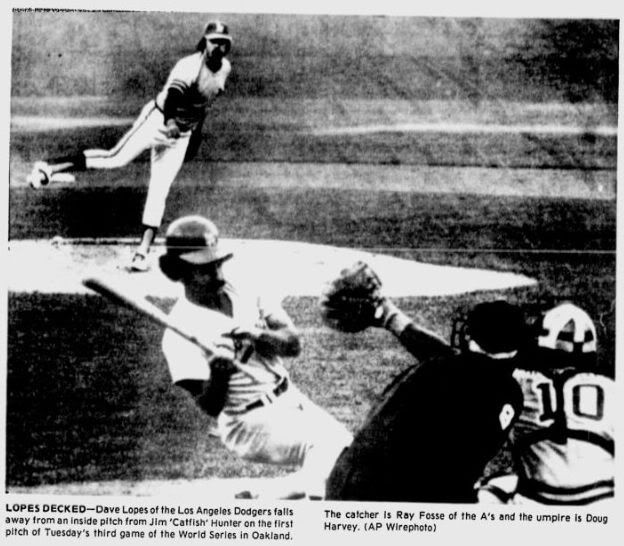
Oakland's ALCS opponent was the Baltimore Orioles for the second year in a row. Though the O's won one more game than the A's, their Pythagorean records gave Oakland an 11-game advantage. Baltimore won Game 1, but the A's proceeded to rattle off three straight wins and take the AL pennant. Incredibly, Oakland only got one hit in the clincher, that being Reggie Jackson's RBI double. They made up for their paucity of punch by drawing 11 walks, one from Gene Tenace with the bases loaded. It was all they needed for a 2-1 win.
These A's faced perhaps their toughest opponent yet in their third World Series. The Dodgers had won 102 games during the season behind a balanced attack that was remarkably similar to Oakland's, and the Blue Crew was seen as the favorite going into the Fall Classic. The A's extended their World Series winning streak to three though, by taking Game 1 3-2. The Dodgers won Game 2 by the same score, but the A's almost came back in the ninth. Pinch-runner Herb Washington (a sprinter with no baseball experience signed specifically to pinch-run) was picked off first for the second out, taking the wind out of Oakland's sails. The A's were unfazed, as they bounced right back to win Game 3 by (again) a 3-2 score. In the fourth contest the score was finally something different, but the result was again an A's win. Pitcher Ken Holtzman hit an unlikely home run in the third, and pinch-hitter Jim Holt's bases-loaded single broke a 2-2 tie in the sixth as Oakland won it 5-2.
For the first time since their run began, the A's didn't require a Game 7 to close out the World Series. Joe Rudi's seventh-inning homer in Game 5 gave the A's their final lead and they went on to win (appropriately) by a score of 3-2. Rollie Fingers was named MVP for his 9.1 innings of ace relief work and two saves. Second baseman Dick Green, though hitless in the Series, was the star on defense, participating in six double plays.
Acknowledgements:
Baseball Reference
Baseball Almanac
Google News Archives
Saturday, November 20, 2010
PTWSW #70: The 1973 Oakland A's
Manager: Dick Williams
Record: 94-68
Ballpark: Oakland-Alameda County Coliseum
Owner: Charles O. Finley
Coaches: Jerry Adair, Vern Hoscheit, Irv Noren, Wes Stock
Future Hall of Famers: Rollie Fingers, Catfish Hunter, Reggie Jackson
All-Stars: Sal Bando, Bert Campaneris, Rollie Fingers, Ken Holtzman, Catfish Hunter, Reggie Jackson
Team Leaders, Batting
BA: Reggie Jackson, .293
OBP: Gene Tenace, .387
SLG: Reggie Jackson, .531 (AL leader)
OPS: Reggie Jackson, .914 (AL leader)
2B: Sal Bando, 32 (AL leader)
3B: Bert Campaneris, 6
HR: Reggie Jackson, 32 (AL leader)
RBI: Reggie Jackson, 117 (AL leader)
BB: Gene Tenace, 101
SB: Bill North, 53
Team Leaders, Pitching
W: Ken Holtzman, Catfish Hunter, 21
SO: Vida Blue, 158
ERA: Ken Holtzman, 2.97
IP: Ken Holtzman, 297.1
CG: Ken Holtzman, 16
SHO: Vida Blue, Ken Holtzman, 4
K/BB: Ken Holtzman, 2.38
SV: Rollie Fingers, 22
Tidbits
Oldest Player: Vic Davalillo (b. July 31, 1936)
Youngest Player: Glenn Abbott (b. February 16, 1951)
First to Leave Us: Gonzalo Marquez (d. December 20, 1984)
Last Survivor: Most are still living as of the date of this post.
First in Majors: Deron Johnson (debut September 20, 1960)
Last in Majors: Manny Trillo (final game May 20, 1989)
First to Play For the Franchise: Deron Johnson (June 15, 1961)
Last to Play For the Franchise: Reggie Jackson (October 4, 1987)
Pre-union Team: The 1968 Cleveland Indians had four: Vic Davalillo, Ray Fosse, Rob Gardner and Horacio Pina.
Reunion Team: The 1978 New York Yankees had five: Ken Holtzman, Catfish Hunter, Reggie Jackson, Jay Johnstone and Paul Lindblad. Perhaps George Steinbrenner targeted these guys because he knew they could win under a meddlesome, overbearing owner.
Accomplishments
Reggie Jackson, AL MVP
Season Summary
Like the previous season, the A's were a top offensive team. They tied for the AL lead in OPS+, were third in homers and second in steals. They were great at avoiding double plays, grounding into the second-fewest twin killings despite frequently being on base, and it may have been what allowed them to score the most runs per game despite playing in a heavy pitcher's park. Their defense was once again fantastic, finishing second in TotalZone and DER, which helped their contact-oriented pitching staff post the fourth-best ERA+ in the Junior Circuit.
 After winning the 1972 World Championship, the A's added some new faces to their lineup in hopes of a repeat. Former Cub outfielder Bill North took over in center, allowing Reggie Jackson to shift to right. First baseman Mike Epstein and catcher Dave Duncan were shipped out, allowing defensively-challenged catcher Gene Tenace's bat to stay in the lineup at first and new acquisition Ray Fosse to take over catching duties. Fosse wasn't the hitter Duncan or Tenace was, but his defense was superb, with 56% of opposing baserunners getting nabbed.
The AL West was a tightly-packed division for the first half of the season. The A's were as low as fifth place in June, but they were never more than six games back. On June 10 Oakland pulled above .500 for good, and before the month was out they'd worked their way into first. The second half was when the standings loosened up, and from August onward it was a two-team race between Oakland and Kansas City. On August 11 the Royals held a two-game lead, but the A's went on a 13-1 run to go up by five. By mid-September the A's had the division all but wrapped up, and they would win the West by six games.
Just as in 1972, the A's were shorthanded during the playoffs; Bill North injured his ankle at the end of September and was sidelined for October. Despite missing their leading base thief, the A's were able to defeat the Baltimore Orioles in the maximum five games in the ALCS. Catfish Hunter was the pitching star of the series, earning a win in Game 2, then tossing a shutout in the clincher. Bert Campaneris was the offensive star, batting .333 and hitting two homers (after clouting only four dingers during the season).
The surprising New York Mets were all that stood in the way of back-to-back Oakland titles. The Amazins had won the weak NL East with an 82-79 record, then upset the 99-win Reds in the NLCS. The A's won a Game 1 pitching duel, but the Mets showed the same mettle they had in reaching the Series by winning Game 2 in twelve innings. Oakland second baseman Mike Andrews allowed Game 2's deciding runs to score on two consecutive errors, and owner Charlie O. Finley was so incensed that he tried to get Andrews replaced on the roster by rookie Manny Trillo. It took an overruling by Commissioner Bowie Kuhn to prevent the move. The two teams split the next four to send the Series to Game 7, and the final match was decided in the third inning, when Campaneris and Reggie Jackson each hit two-run homers (the only Oakland round-trippers of the Series). The A's would hold onto the lead for a 5-2 win.
The A's became the first team to win back-to-back World Series since the 1961-62 Yankees. The victory was bittersweet though, as manager Dick Williams resigned immediately after Game 7, citing "personal reasons." Jackson was named MVP of the Series for his six RBI and five extra-base hits.
Acknowledgements:
Baseball Reference
Baseball Almanac
Google News Archives
Record: 94-68
Ballpark: Oakland-Alameda County Coliseum
Owner: Charles O. Finley
Coaches: Jerry Adair, Vern Hoscheit, Irv Noren, Wes Stock
Future Hall of Famers: Rollie Fingers, Catfish Hunter, Reggie Jackson
All-Stars: Sal Bando, Bert Campaneris, Rollie Fingers, Ken Holtzman, Catfish Hunter, Reggie Jackson
Team Leaders, Batting
BA: Reggie Jackson, .293
OBP: Gene Tenace, .387
SLG: Reggie Jackson, .531 (AL leader)
OPS: Reggie Jackson, .914 (AL leader)
2B: Sal Bando, 32 (AL leader)
3B: Bert Campaneris, 6
HR: Reggie Jackson, 32 (AL leader)
RBI: Reggie Jackson, 117 (AL leader)
BB: Gene Tenace, 101
SB: Bill North, 53
Team Leaders, Pitching
W: Ken Holtzman, Catfish Hunter, 21
SO: Vida Blue, 158
ERA: Ken Holtzman, 2.97
IP: Ken Holtzman, 297.1
CG: Ken Holtzman, 16
SHO: Vida Blue, Ken Holtzman, 4
K/BB: Ken Holtzman, 2.38
SV: Rollie Fingers, 22
Tidbits
Oldest Player: Vic Davalillo (b. July 31, 1936)
Youngest Player: Glenn Abbott (b. February 16, 1951)
First to Leave Us: Gonzalo Marquez (d. December 20, 1984)
Last Survivor: Most are still living as of the date of this post.
First in Majors: Deron Johnson (debut September 20, 1960)
Last in Majors: Manny Trillo (final game May 20, 1989)
First to Play For the Franchise: Deron Johnson (June 15, 1961)
Last to Play For the Franchise: Reggie Jackson (October 4, 1987)
Pre-union Team: The 1968 Cleveland Indians had four: Vic Davalillo, Ray Fosse, Rob Gardner and Horacio Pina.
Reunion Team: The 1978 New York Yankees had five: Ken Holtzman, Catfish Hunter, Reggie Jackson, Jay Johnstone and Paul Lindblad. Perhaps George Steinbrenner targeted these guys because he knew they could win under a meddlesome, overbearing owner.
Accomplishments
Reggie Jackson, AL MVP
Season Summary
Like the previous season, the A's were a top offensive team. They tied for the AL lead in OPS+, were third in homers and second in steals. They were great at avoiding double plays, grounding into the second-fewest twin killings despite frequently being on base, and it may have been what allowed them to score the most runs per game despite playing in a heavy pitcher's park. Their defense was once again fantastic, finishing second in TotalZone and DER, which helped their contact-oriented pitching staff post the fourth-best ERA+ in the Junior Circuit.
 After winning the 1972 World Championship, the A's added some new faces to their lineup in hopes of a repeat. Former Cub outfielder Bill North took over in center, allowing Reggie Jackson to shift to right. First baseman Mike Epstein and catcher Dave Duncan were shipped out, allowing defensively-challenged catcher Gene Tenace's bat to stay in the lineup at first and new acquisition Ray Fosse to take over catching duties. Fosse wasn't the hitter Duncan or Tenace was, but his defense was superb, with 56% of opposing baserunners getting nabbed.
The AL West was a tightly-packed division for the first half of the season. The A's were as low as fifth place in June, but they were never more than six games back. On June 10 Oakland pulled above .500 for good, and before the month was out they'd worked their way into first. The second half was when the standings loosened up, and from August onward it was a two-team race between Oakland and Kansas City. On August 11 the Royals held a two-game lead, but the A's went on a 13-1 run to go up by five. By mid-September the A's had the division all but wrapped up, and they would win the West by six games.
Just as in 1972, the A's were shorthanded during the playoffs; Bill North injured his ankle at the end of September and was sidelined for October. Despite missing their leading base thief, the A's were able to defeat the Baltimore Orioles in the maximum five games in the ALCS. Catfish Hunter was the pitching star of the series, earning a win in Game 2, then tossing a shutout in the clincher. Bert Campaneris was the offensive star, batting .333 and hitting two homers (after clouting only four dingers during the season).
The surprising New York Mets were all that stood in the way of back-to-back Oakland titles. The Amazins had won the weak NL East with an 82-79 record, then upset the 99-win Reds in the NLCS. The A's won a Game 1 pitching duel, but the Mets showed the same mettle they had in reaching the Series by winning Game 2 in twelve innings. Oakland second baseman Mike Andrews allowed Game 2's deciding runs to score on two consecutive errors, and owner Charlie O. Finley was so incensed that he tried to get Andrews replaced on the roster by rookie Manny Trillo. It took an overruling by Commissioner Bowie Kuhn to prevent the move. The two teams split the next four to send the Series to Game 7, and the final match was decided in the third inning, when Campaneris and Reggie Jackson each hit two-run homers (the only Oakland round-trippers of the Series). The A's would hold onto the lead for a 5-2 win.
The A's became the first team to win back-to-back World Series since the 1961-62 Yankees. The victory was bittersweet though, as manager Dick Williams resigned immediately after Game 7, citing "personal reasons." Jackson was named MVP of the Series for his six RBI and five extra-base hits.
Acknowledgements:
Baseball Reference
Baseball Almanac
Google News Archives
Friday, November 5, 2010
PTWSW #69: The 1972 Oakland A's
Manager: Dick Williams
Record: 93-62
Ballpark: Oakland-Alameda County Coliseum
Owner: Charles O. Finley
Coaches: Jerry Adair, Vern Hoscheit, Irv Noren, Bill Posedel
Future Hall of Famers: Orlando Cepeda, Rollie Fingers, Catfish Hunter, Reggie Jackson,
All-Stars: Sal Bando, Bert Campaneris, Ken Holtzman, Catfish Hunter, Reggie Jackson, Joe Rudi
Team Leaders, Batting
BA: Joe Rudi, .305
OBP: Mike Epstein, .376
SLG: Mike Epstein, .490
OPS: Mike Epstein, .866
2B: Joe Rudi, 32
3B: Joe Rudi, 9 (AL leader)
HR: Mike Epstein, 26
RBI: Sal Bando, 77
BB: Sal Bando, 78
SB: Bert Campaneris, 52 (AL leader)
Team Leaders, Pitching
W: Catfish Hunter, 21
SO: Catfish Hunter, 191
ERA: Catfish Hunter, 2.04
IP: Catfish Hunter, 295.1
CG: Ken Holtzman, Catfish Hunter, 16
SHO: Catfish Hunter, 5
K/BB: Catfish Hunter, 2.73
SV: Rollie Fingers, 21
Tidbits
Oldest Player: Joe Horlen (b. August 14, 1937). Horlen was just three days older than teammate Diego Segui.
Youngest Player: George Hendrick (b. October 18, 1949)
First to Leave Us: Gonzalo Marquez (d. December 20, 1984). Marquez, then a player-coach for the Caracas Leones of the Venezuelan Winter League, was killed by a drunk driver while on his way home from a game.
Last Survivor: Most are still living as of the date of this post.
First in Majors: Orlando Cepeda (debut April 15, 1958)
Last in Majors: George Hendrick (final game October 2, 1988)
First to Play For the Franchise: Diego Segui (April 12, 1962). Segui was traded to the Cardinals in June, so he unfortunately didn't get to be a part of the victory celebration.
Last to Play For the Franchise: Reggie Jackson (October 4, 1987)
Pre-union Team: The 1969 Seattle Pilots had six: Ron Clark, Larry Haney, Mike Hegan, Bob Locker, Don Mincher and Diego Segui.
Reunion Team: The 1973 St. Louis Cardinals had four: Matty Alou, Dwain Anderson, Larry Haney and Diego Segui.
Season Summary
The A's were one of the most colorful teams to come along in years. They wore flashy green and gold uniforms, sported moustaches and long hair, and were constantly making headlines thanks to controversial and outspoken owner Charlie O. Finley. Their owner and look weren't the only thing that set them apart; they were also the best team in the American League. The "Swingin' A's" led the AL in OPS+ and home runs, and were second in slugging, though their batting and on-base averages were only middle-of-the-road. They finished third in steals thanks mostly to shortstop Bert Campaneris' league-leading 52 swipes. They were also strong on the other side of the ball, with a third-ranked TotalZone and ERA+. Their staff exhibited good control, with a low walk rate and the second-fewest hit batsmen and wild pitches.
 After the brief strike that delayed Opening Day by a week, the biggest early-season story was the holdout of 1971 Cy Young winner and MVP Vida Blue. Blue eventually agreed to terms in early May and made his debut at the end of the month, but he never shook off the rust, as he didn't live up to the standard he'd set the year before. It was OK though, as Catfish Hunter, Blue Moon Odom and offseason addition Ken Holtzman picked up the slack in the starting rotation. Oakland spent most of the year leading the AL West, though the White Sox briefly pulled ahead with a hot August. The A's responded by tinkering with their starting lineup, putting Gene Tenace at catcher and new acquisition Matty Alou in right field. The A's quickly jumped back into first, and they went on to win the division by 5.5 games.
The ALCS against the Tigers was a dramatic affair, going the full five games, two being decided on extra-inning comebacks. The A's won the first two in Oakland, and in Game 2 Campaneris got himself suspended for the rest of the series for throwing his bat at Detroit reliever Lerrin LaGrow. The Tigers took the next two at home to even things up, their Game 4 victory coming on a three-run rally in the tenth inning. Missing their leadoff man and coming off a crushing defeat, the A's had to win Game 5 in Detroit the very next day. They ended up being successful, as Odom and Blue allowed only one run between them. The only bad news to come out of the final game was that center fielder Reggie Jackson was injured stealing home and had to miss the World Series.
The World Series matchup provided a distinct contrast between the shaggy, stylish A's and the conservative, clean-cut Cincinnati Reds. Cincinnati was favored to win it, especially so with Jackson sidelined. The A's quickly erased any doubts that they could compete with Cincy by winning the first two games on the road. Tenace's two homers provided the margin of victory in Game 1, and left fielder Joe Rudi saved Game 2 by robbing the Reds' Denis Menke of an extra-base hit in the ninth. The Reds bounced back with a 1-0 victory in Game 3, but the A's took a 3-1 series lead by scoring two runs on four straight singles in the ninth inning of Game 4. The Reds weren't done yet, winning the next two to force Game 7 in Cincinnati. Like they had in the ALCS, the A's won the sudden death game on the road. Tenace was again the hero, driving in two runs in Oakland's 3-2 victory. It was the franchise's first World Series title since 1930, when it was based in Philadelphia and Connie Mack was the owner. Tenace was named Series MVP for his .348 average, four homers and nine RBI.
Acknowledgements:
Baseball Reference
Baseball Almanac
Google News Archives
Record: 93-62
Ballpark: Oakland-Alameda County Coliseum
Owner: Charles O. Finley
Coaches: Jerry Adair, Vern Hoscheit, Irv Noren, Bill Posedel
Future Hall of Famers: Orlando Cepeda, Rollie Fingers, Catfish Hunter, Reggie Jackson,
All-Stars: Sal Bando, Bert Campaneris, Ken Holtzman, Catfish Hunter, Reggie Jackson, Joe Rudi
Team Leaders, Batting
BA: Joe Rudi, .305
OBP: Mike Epstein, .376
SLG: Mike Epstein, .490
OPS: Mike Epstein, .866
2B: Joe Rudi, 32
3B: Joe Rudi, 9 (AL leader)
HR: Mike Epstein, 26
RBI: Sal Bando, 77
BB: Sal Bando, 78
SB: Bert Campaneris, 52 (AL leader)
Team Leaders, Pitching
W: Catfish Hunter, 21
SO: Catfish Hunter, 191
ERA: Catfish Hunter, 2.04
IP: Catfish Hunter, 295.1
CG: Ken Holtzman, Catfish Hunter, 16
SHO: Catfish Hunter, 5
K/BB: Catfish Hunter, 2.73
SV: Rollie Fingers, 21
Tidbits
Oldest Player: Joe Horlen (b. August 14, 1937). Horlen was just three days older than teammate Diego Segui.
Youngest Player: George Hendrick (b. October 18, 1949)
First to Leave Us: Gonzalo Marquez (d. December 20, 1984). Marquez, then a player-coach for the Caracas Leones of the Venezuelan Winter League, was killed by a drunk driver while on his way home from a game.
Last Survivor: Most are still living as of the date of this post.
First in Majors: Orlando Cepeda (debut April 15, 1958)
Last in Majors: George Hendrick (final game October 2, 1988)
First to Play For the Franchise: Diego Segui (April 12, 1962). Segui was traded to the Cardinals in June, so he unfortunately didn't get to be a part of the victory celebration.
Last to Play For the Franchise: Reggie Jackson (October 4, 1987)
Pre-union Team: The 1969 Seattle Pilots had six: Ron Clark, Larry Haney, Mike Hegan, Bob Locker, Don Mincher and Diego Segui.
Reunion Team: The 1973 St. Louis Cardinals had four: Matty Alou, Dwain Anderson, Larry Haney and Diego Segui.
Season Summary
The A's were one of the most colorful teams to come along in years. They wore flashy green and gold uniforms, sported moustaches and long hair, and were constantly making headlines thanks to controversial and outspoken owner Charlie O. Finley. Their owner and look weren't the only thing that set them apart; they were also the best team in the American League. The "Swingin' A's" led the AL in OPS+ and home runs, and were second in slugging, though their batting and on-base averages were only middle-of-the-road. They finished third in steals thanks mostly to shortstop Bert Campaneris' league-leading 52 swipes. They were also strong on the other side of the ball, with a third-ranked TotalZone and ERA+. Their staff exhibited good control, with a low walk rate and the second-fewest hit batsmen and wild pitches.

The ALCS against the Tigers was a dramatic affair, going the full five games, two being decided on extra-inning comebacks. The A's won the first two in Oakland, and in Game 2 Campaneris got himself suspended for the rest of the series for throwing his bat at Detroit reliever Lerrin LaGrow. The Tigers took the next two at home to even things up, their Game 4 victory coming on a three-run rally in the tenth inning. Missing their leadoff man and coming off a crushing defeat, the A's had to win Game 5 in Detroit the very next day. They ended up being successful, as Odom and Blue allowed only one run between them. The only bad news to come out of the final game was that center fielder Reggie Jackson was injured stealing home and had to miss the World Series.
The World Series matchup provided a distinct contrast between the shaggy, stylish A's and the conservative, clean-cut Cincinnati Reds. Cincinnati was favored to win it, especially so with Jackson sidelined. The A's quickly erased any doubts that they could compete with Cincy by winning the first two games on the road. Tenace's two homers provided the margin of victory in Game 1, and left fielder Joe Rudi saved Game 2 by robbing the Reds' Denis Menke of an extra-base hit in the ninth. The Reds bounced back with a 1-0 victory in Game 3, but the A's took a 3-1 series lead by scoring two runs on four straight singles in the ninth inning of Game 4. The Reds weren't done yet, winning the next two to force Game 7 in Cincinnati. Like they had in the ALCS, the A's won the sudden death game on the road. Tenace was again the hero, driving in two runs in Oakland's 3-2 victory. It was the franchise's first World Series title since 1930, when it was based in Philadelphia and Connie Mack was the owner. Tenace was named Series MVP for his .348 average, four homers and nine RBI.
Acknowledgements:
Baseball Reference
Baseball Almanac
Google News Archives
Tuesday, September 21, 2010
PTWSW #68: The 1971 Pittsburgh Pirates
Manager: Danny Murtaugh
Record: 97-65
Ballpark: Three Rivers Stadium
Owner: John W. Galbreath
GM: Joe L. Brown
Coaches: Don Leppert, Frank Oceak, Don Osborn, Dave Ricketts, Bill Virdon
Future Hall of Famers: Roberto Clemente, Bill Mazeroski, Willie Stargell
All-Stars: Roberto Clemente, Dock Ellis, Manny Sanguillen, Willie Stargell
Team Leaders, Batting
BA: Roberto Clemente, .341
OBP: Willie Stargell, .398
SLG: Willie Stargell, .628
OPS: Willie Stargell, 1.026
2B: Al Oliver, 31
3B: Roberto Clemente, Richie Hebner, 8
HR: Willie Stargell, 48 (NL leader)
RBI: Willie Stargell, 125
BB: Willie Stargell, 83
SB: Gene Clines, 15
Team Leaders, Pitching
W: Dock Ellis, 19
SO: Dock Ellis, 137
ERA: Steve Blass, 2.85
IP: Steve Blass, 240
CG: Steve Blass, 12
SHO: Steve Blass, 5 (NL leader)
K/BB: Dock Ellis, 2.17
SV: Dave Giusti, 30 (NL leader)
Tidbits
Oldest Player: Roberto Clemente (b. August 18, 1934)
Youngest Player: Rennie Stennett (b. April 5, 1951)
First to Leave Us: Roberto Clemente (d. December 31, 1972) Just two months after the 1972 season ended Clemente headed a relief effort for earthquake victims in Nicaragua. Clemente decided to accompany a shipment of supplies personally, but the plane was old and overloaded, and it crashed into the sea shortly after takeoff.
Last Survivor: Most are still living as of the date of this post.
First in Majors: Roberto Clemente (debut April 17, 1955)
Last in Majors: Al Oliver and Bruce Kison both played their final regular season games on October 5, 1985, though Oliver's final appearance in a big league contest came in Game 7 of the ALCS, on October 16. It should be noted that Kison and Oliver both announced their retirements in February 1986, while Richie Hebner, who made his final appearance on October 3, 1985, didn't retire until after he was released by the Cubs in Spring Training.
First to Play For the Franchise: Roberto Clemente (April 17, 1955)
Last to Play For the Franchise: Milt May (September 30, 1984)
Pre-union Team: The 1969 Cardinals had four: Nelson Briles, Vic Davalillo, Dave Giusti and Mudcat Grant.
Reunion Team: The 1977 Athletics (Dock Ellis, Dave Giusti, Manny Sanguillen), 1977 Cubs (Gene Clines, Dave Giusti, Ramon Hernandez), 1978-79 Rangers (Dock Ellis, Al Oliver, Richie Zisk) and 1979 Mets (Dock Ellis, Richie Hebner, Frank Taveras) each had three. Hmmm. It seems that wherever Dock Ellis went in the late '70s he found two of his former '71 Pirate teammates.
Accomplishments
Roberto Clemente, NL Outfield Gold Glove
Season Summary
The Pirates were the best offensive team in the NL, mainly due to their proficiency at bashing the ball. They led the NL in homers, triples, slugging percentage and OPS+, and finished second in batting and on-base average. They were strong on the other side of the ball too: Their defense was second in TotalZone, and their pitching staff was fourth in ERA+. Their hurlers generally pitched to contact, as their walk and strikeout rates were low. Though they allowed more hits than average, they mimimized the damage by posting the fourth-best opponents' slugging percentage.
It was close at the top of the NL East for the first two months of the season, but the Pirates took over the lead for good in June. An 11-game winning streak in July gave them a buffer which allowed them to weather a cool spell the next month. On September 1 the Pirates made history by employing the first all-black starting lineup in a win over the Phillies. Given the diversity on their roster, it nearly went unnoticed by some players. Three weeks later Pittsburgh clinched the division title by beating the Cardinals 5-1.
 The NLCS matched the Pirates up with the Giants, against whom they'd gone 3-9 in the regular season. All that record indicated was that the Pirates were due. San Francisco took Game 1, but the Pirates won the next three to take the NL pennant. If there'd been an LCS MVP it surely would've gone to first baseman Bob Robertson, who hit four homers and put up an OPS of 1.688 in the four games.
The Pirates' World Series opponent was the Baltimore Orioles, the 1970 champions playing in their third straight Fall Classic. The Orioles were riding a hot streak, winners of their last 11 regular season games and fresh off an ALCS sweep of the Oakland A's. They stretched it to 16 in a row by taking Games 1 and 2 at home. When the Series shifted to Pittsburgh the Pirates were able to get back in it. Buc ace Steve Blass pitched a three-hitter in Game 3, while backup catcher Milt May's single provided the go-ahead run in Game 4 (the first World Series contest played under the lights). Stretch run hero Nelson Briles pitched a shutout in Game 5 to give Pittsburgh a 3-2 lead heading back to Baltimore. The home-team winner trend continued in Game 6, as Brooks Robinson's tenth-inning sac fly knotted up the Series. Blass returned to the mound for the deciding match, and he outdueled Baltimore's Mike Cuellar for his second complete-game victory. Roberto Clemente, who hit .414 with two homers in the Series, was named MVP.
One month after the World Series ended, manager Danny Murtaugh stepped down citing health concerns. He would be replaced by coach and former player Bill Virdon.
Acknowledgements:
Baseball Reference
Baseball Almanac
Google News Archives
Thirty Years Ago...The First All-Black Lineup by Bruce Markusen
Record: 97-65
Ballpark: Three Rivers Stadium
Owner: John W. Galbreath
GM: Joe L. Brown
Coaches: Don Leppert, Frank Oceak, Don Osborn, Dave Ricketts, Bill Virdon
Future Hall of Famers: Roberto Clemente, Bill Mazeroski, Willie Stargell
All-Stars: Roberto Clemente, Dock Ellis, Manny Sanguillen, Willie Stargell
Team Leaders, Batting
BA: Roberto Clemente, .341
OBP: Willie Stargell, .398
SLG: Willie Stargell, .628
OPS: Willie Stargell, 1.026
2B: Al Oliver, 31
3B: Roberto Clemente, Richie Hebner, 8
HR: Willie Stargell, 48 (NL leader)
RBI: Willie Stargell, 125
BB: Willie Stargell, 83
SB: Gene Clines, 15
Team Leaders, Pitching
W: Dock Ellis, 19
SO: Dock Ellis, 137
ERA: Steve Blass, 2.85
IP: Steve Blass, 240
CG: Steve Blass, 12
SHO: Steve Blass, 5 (NL leader)
K/BB: Dock Ellis, 2.17
SV: Dave Giusti, 30 (NL leader)
Tidbits
Oldest Player: Roberto Clemente (b. August 18, 1934)
Youngest Player: Rennie Stennett (b. April 5, 1951)
First to Leave Us: Roberto Clemente (d. December 31, 1972) Just two months after the 1972 season ended Clemente headed a relief effort for earthquake victims in Nicaragua. Clemente decided to accompany a shipment of supplies personally, but the plane was old and overloaded, and it crashed into the sea shortly after takeoff.
Last Survivor: Most are still living as of the date of this post.
First in Majors: Roberto Clemente (debut April 17, 1955)
Last in Majors: Al Oliver and Bruce Kison both played their final regular season games on October 5, 1985, though Oliver's final appearance in a big league contest came in Game 7 of the ALCS, on October 16. It should be noted that Kison and Oliver both announced their retirements in February 1986, while Richie Hebner, who made his final appearance on October 3, 1985, didn't retire until after he was released by the Cubs in Spring Training.
First to Play For the Franchise: Roberto Clemente (April 17, 1955)
Last to Play For the Franchise: Milt May (September 30, 1984)
Pre-union Team: The 1969 Cardinals had four: Nelson Briles, Vic Davalillo, Dave Giusti and Mudcat Grant.
Reunion Team: The 1977 Athletics (Dock Ellis, Dave Giusti, Manny Sanguillen), 1977 Cubs (Gene Clines, Dave Giusti, Ramon Hernandez), 1978-79 Rangers (Dock Ellis, Al Oliver, Richie Zisk) and 1979 Mets (Dock Ellis, Richie Hebner, Frank Taveras) each had three. Hmmm. It seems that wherever Dock Ellis went in the late '70s he found two of his former '71 Pirate teammates.
Accomplishments
Roberto Clemente, NL Outfield Gold Glove
Season Summary
The Pirates were the best offensive team in the NL, mainly due to their proficiency at bashing the ball. They led the NL in homers, triples, slugging percentage and OPS+, and finished second in batting and on-base average. They were strong on the other side of the ball too: Their defense was second in TotalZone, and their pitching staff was fourth in ERA+. Their hurlers generally pitched to contact, as their walk and strikeout rates were low. Though they allowed more hits than average, they mimimized the damage by posting the fourth-best opponents' slugging percentage.
It was close at the top of the NL East for the first two months of the season, but the Pirates took over the lead for good in June. An 11-game winning streak in July gave them a buffer which allowed them to weather a cool spell the next month. On September 1 the Pirates made history by employing the first all-black starting lineup in a win over the Phillies. Given the diversity on their roster, it nearly went unnoticed by some players. Three weeks later Pittsburgh clinched the division title by beating the Cardinals 5-1.
 The NLCS matched the Pirates up with the Giants, against whom they'd gone 3-9 in the regular season. All that record indicated was that the Pirates were due. San Francisco took Game 1, but the Pirates won the next three to take the NL pennant. If there'd been an LCS MVP it surely would've gone to first baseman Bob Robertson, who hit four homers and put up an OPS of 1.688 in the four games.
The Pirates' World Series opponent was the Baltimore Orioles, the 1970 champions playing in their third straight Fall Classic. The Orioles were riding a hot streak, winners of their last 11 regular season games and fresh off an ALCS sweep of the Oakland A's. They stretched it to 16 in a row by taking Games 1 and 2 at home. When the Series shifted to Pittsburgh the Pirates were able to get back in it. Buc ace Steve Blass pitched a three-hitter in Game 3, while backup catcher Milt May's single provided the go-ahead run in Game 4 (the first World Series contest played under the lights). Stretch run hero Nelson Briles pitched a shutout in Game 5 to give Pittsburgh a 3-2 lead heading back to Baltimore. The home-team winner trend continued in Game 6, as Brooks Robinson's tenth-inning sac fly knotted up the Series. Blass returned to the mound for the deciding match, and he outdueled Baltimore's Mike Cuellar for his second complete-game victory. Roberto Clemente, who hit .414 with two homers in the Series, was named MVP.
One month after the World Series ended, manager Danny Murtaugh stepped down citing health concerns. He would be replaced by coach and former player Bill Virdon.
Acknowledgements:
Baseball Reference
Baseball Almanac
Google News Archives
Thirty Years Ago...The First All-Black Lineup by Bruce Markusen
Subscribe to:
Posts (Atom)