Saturday, May 29, 2010

PTWSW #52: The 1955 Brooklyn Dodgers

Manager: Walter Alston
Record: 98-55
Ballpark: Ebbets Field
Owners: Walter O'Malley, Mary Louise Smith, James & Dearie Mulvey
GM: Buzzie Bavasi
Coaches: Joe Becker, Billy Herman, Jake Pitler

Future Hall of Famers: Roy Campanella, Sandy Koufax, Tommy Lasorda, Pee Wee Reese, Jackie Robinson, Duke Snider

All-Stars: Roy Campanella, Gil Hodges, Don Newcombe, Duke Snider

Team Leaders, Batting

BA:
Roy Campanella, .318
OBP: Duke Snider, .418
SLG: Duke Snider, .628
OPS: Duke Snider, 1.046
2B: Duke Snider, 34
3B: Jim Gilliam, 8
HR: Duke Snider, 42
RBI: Duke Snider, 136 (NL leader)
BB: Duke Snider, 104
SB: Jim Gilliam, 15

Team Leaders, Pitching

W:
Don Newcombe, 20
SO: Don Newcombe, 143
ERA: Don Newcombe, 3.20
IP: Don Newcombe, 233.2
CG: Don Newcombe, 17
SHO: Carl Erskine, Sandy Koufax, Johnny Podres, 2
K/BB: Don Newcombe, 3.76 (NL leader)
SV: Ed Roebuck, 12

Tidbits

Oldest Player: Pee Wee Reese (b. July 23, 1918)

Youngest Player: Sandy Koufax (b. December 30, 1935)

First to Leave Us: Don Hoak (d. October 9, 1969). Hoak had a fatal heart attack behind the wheel of a car when he was chasing his brother-in-law's stolen vehicle.

Last Survivor: As of April 16, 2024, Sandy Koufax is the only one living.

First in Majors: Pee Wee Reese (debut April 23, 1940)

Last in Majors: Johnny Podres (final game June 21, 1969)

First to Play For the Franchise: Pee Wee Reese (April 23, 1940)

Last to Play For the Franchise: Jim Gilliam and Sandy Koufax both played their final game in a Dodger uniform on October 6, 1966, which also happened to be Game 2 of the World Series.

Pre-union Team: Since most of these players were developed through the heralded Dodger farm system, no team had more than two.

Reunion Team: The 1956 Chicago Cubs, thanks mostly to one offseason trade, had five (Don Hoak, Jim Hughes, Frank Kellert, Russ Meyer and Walt Moryn). The 1962 New York Mets, a first-year expansion team attempting to draw fans with some of the city's former stars, had four (Roger Craig, Gil Hodges, Clem Labine and Don Zimmer).

Accomplishments

Roy Campanella, NL MVP

Season Summary

Throughout the 1950's the Dodgers had been successful with a dominant offense and merely-above-average pitching. In 1955 their hurlers finally caught up with their hitters. Brooklyn led the league in ERA+, their strikeout rate topped the NL and their walk rate was second-best. On offense they didn't miss a beat, leading the league in OPS+, doubles, home runs and stolen bases while averaging the most runs per game. Their TotalZone rating was also tops in the Senior Circuit. It should be no surprise then, that the Dodgers set a modern Major League record with ten straight victories to start the season and never looked back, winning the pennant by 13.5 games.

"Dem Bums" had a reputation. They had seven National League pennants to their name, but not a single World Series victory. Their last five defeats had all been at the hands of the New York Yankees, and for the fifth time in nine years they'd have a crack at the Bronx Bombers in the Fall Classic. Would this year be different? The Yanks took Game 1 in Yankee Stadium, a match best remembered for Jackie Robinson's steal of home to pull the Dodgers within one run. New York followed up that victory with another the next day to take a 2-0 Series lead. A return to Ebbets Field was exactly what the Dodgers needed to get back on track, as they won all three of their home games to take the Series lead. Back in Yankee Stadium for Game 6, the Pinstripers continued the home-field trend with another victory, forcing Game 7. The final pitching matchup was young Dodger Johnny Podres versus veteran Yankee Tommy Byrne. The Dodgers carried a 2-0 lead into the sixth, where defensive replacement Sandy Amoros made the defining play of the Series: with two on and nobody out, Yogi Berra hit a drive down the left field line that Amoros caught on the run and fired back to the infield for a double play. The Dodgers held on to win the game, capturing the only World Series title they'd win in Brooklyn. Podres was named World Series MVP for his complete-game victories in Games 3 and 7.

Acknowledgements:

Baseball Reference
Baseball Almanac
Google News Archives

Friday, May 21, 2010

PTWSW #51: The 1954 New York Giants

Manager: Leo Durocher
Record: 97-57
Ballpark: Polo Grounds
Owner: Horace Stoneham
VP: Charles Feeney
Coaches: Freddie Fitzsimmons, Herman Franks, Larry Jansen, Frank Shellenback

Future Hall of Famers: Monte Irvin, Willie Mays, Hoyt Wilhelm

All-Stars: Johnny Antonelli, Alvin Dark, Marv Grissom, Willie Mays, Don Mueller

Team Leaders, Batting

BA:
Willie Mays, .345 (NL leader)
OBP: Willie Mays, .411
SLG: Willie Mays, .667 (NL leader)
OPS: Willie Mays, 1.078 (NL leader)
2B: Don Mueller, 35
3B: Willie Mays, 13 (NL leader)
HR: Willie Mays, 41
RBI: Willie Mays, 110
BB: Hank Thompson, 90
SB: Willie Mays, 8

Team Leaders, Pitching

W:
Johnny Antonelli, 21
SO: Johnny Antonelli, 152
ERA: Johnny Antonelli, 2.30 (NL leader)
IP: Johnny Antonelli, 258.2
CG: Johnny Antonelli, 18
SHO: Johnny Antonelli, 6 (NL leader)
K/BB: Sal Maglie, 1.67
SV: Marv Grissom, 19

Tidbits

Oldest Player:
Sal Maglie (b. April 26, 1917)

Youngest Player: Joey Amalfitano (b. January 23, 1934)

First to Leave Us: Hank Thompson (d. September 30, 1969)

Last Survivor: Joey Amalfitano is the only one living as of July 14, 2026.

First in Majors: Hoot Evers (debut September 16, 1941)

Last in Majors: Willie Mays (final game September 9, 1973). Mays actually played his final game with the Mets in the 1973 World Series.

First to Play For the Franchise: Whitey Lockman (July 5, 1945)

Last to Play For the Franchise: Willie Mays (May 9, 1972)

Pre-union Team: The 1953 Milwaukee Braves had three: Johnny Antonelli, Don Liddle and Ebba St. Claire. All were acquired in the same pre-season trade.

Reunion Team: The 1956 St. Louis Cardinals had four: Alvin Dark, Ray Katt, Don Liddle and Whitey Lockman. All were shipped out in the same mid-season trade.

Accomplishments

Willie Mays, NL MVP
Don Mueller, cycle on July 11

Season Summary

Willie Mays' return from the Army was exactly the boost the Giants needed to jump from fifth place to first. Mays had an MVP season, leading the league with a 175 OPS+ and hitting .345 to win the batting title. He also hit 31 home runs before the All-Star Break, spurring talk of a run at Babe Ruth's single-season record. The Say Hey Kid would finish with only 41, but what he lost in power during the second half he made up for with an improved on-base percentage.

Stellar team defense was the biggest key to the Giants' success. They led the league in DER as well as TotalZone rating. Their pitching staff had an incredible 132 ERA+, but their strikeout rate was only the NL's second-best and their walk rate second-worst, suggesting that their glovework was responsible for much of their run prevention. On offense the only slash stat in which they were above average was slugging percentage. They tied for the league lead in home runs, and their team OPS+ was a third-best 95.

The pennant race essentially came down to the Giants and their city rivals, the Brooklyn Dodgers. The Giants made their way into first place for good on June 12, but Brooklyn stayed on their tails until the final month. The Giants finally clinched with a 7-1 victory over the Dodgers on September 20. For the fourth year in a row the National League representative in the Fall Classic would hail from the Big Apple.

The 1954 American League Champions were the Cleveland Indians, another team with a power-based offense and outstanding pitching and defense. The Indians had set an American League record with 111 wins that season, making them the heavy favorite. Game 1 became legendary for "The Catch," when Mays hauled in a deep drive off the bat of Vic Wertz with his back to the plate to preserve a 2-2 tie. The decisive moment, however, was when pinch-hitter Dusty Rhodes, still fuming from being left out of the starting lineup, delivered a three-run homer off Bob Lemon in the 10th inning to give the Giants a 1-0 Series lead. Rhodes was again a hero in New York's Game 2 victory, tying the game with a pinch-hit single and later delivering an insurance run with a solo homer. The Series shifted to Cleveland for Game 3, but the Indians' luck was no better at home. Rhodes delivered yet another key pinch-hit, driving in two runs and giving the Giants a 3-0 lead in a game they'd win 6-2. The demoralized Indians went down 7-4 in the final game, and the Giants had pulled off one of the biggest upsets in baseball history.

Acknowledgements:

Baseball Reference
Baseball Almanac
Google News Archives

Sunday, May 2, 2010

PTWSW #50: The 1953 New York Yankees

Manager: Casey Stengel
Record: 99-52
Ballpark: Yankee Stadium
Owner: Dan Topping and Del Webb
GM: George Weiss
Coaches: Frankie Crosetti, Bill Dickey, Ralph Houk, Jim Turner

Future Hall of Famers: Yogi Berra, Whitey Ford, Mickey Mantle, Johnny Mize, Phil Rizzuto

All-Stars: Hank Bauer, Yogi Berra, Mickey Mantle, Johnny Mize, Allie Reynolds, Phil Rizzuto, Johnny Sain

Team Leaders, Batting

BA:
Gene Woodling, .306
OBP: Gene Woodling, .429 (AL leader)
SLG: Yogi Berra, .523
OPS: Gene Woodling, .898
2B: Gil McDougald, 27
3B: Gil McDougald, 7
HR: Yogi Berra, 27
RBI: Yogi Berra, 108
BB: Gene Woodling, 82
SB: Mickey Mantle, 8

Team Leaders, Pitching

W:
Whitey Ford, 18
SO: Whitey Ford, 110
ERA: Ed Lopat, 2.42 (AL leader)
IP: Whitey Ford, 207
CG: Whitey Ford, 11
SHO: Vic Raschi, 4
K/BB: Johnny Sain, 1.87 (AL leader)
SV: Allie Reynolds, 13

Tidbits

Oldest Player: Johnny Mize (b. January 7, 1913)

Youngest Player: Mickey Mantle (b. October 20, 1931)

First to Leave Us: Ray Scarborough (d. July 1, 1982)

Last Survivor: Art Schallock (d. March 6, 2025)

First in Majors: Johnny Mize (debut April 16, 1936)

Last in Majors: Mickey Mantle (final game September 28, 1968)

First to Play For the Franchise: Phil Rizzuto (April 14, 1941)

Last to Play For the Franchise: Mickey Mantle (September 28, 1968)

Pre-union Team: The 1946 Indians and 1950-51 Senators each had three.

Reunion Team: The 1955 Orioles had eight: Bob Kuzava, Ed Lopat, Jim McDonald, Bill Miller, Willy Miranda, Art Schallock, Gus Triandos and Gene Woodling. Five of them were part of a humongous seventeen-player swap the Yankees and Orioles made in November 1954.

Season Summary

The final team of the Yankees' five-year title streak may have been the best of them all. The 1953 Bronx Bombers were never out of first place after April 21, and an early 33-6 run (which included an 18-game winning streak) gave them a cushion that allowed them to withstand the nine-game losing streak that followed. On offense the Yankees were without peer, as they led the AL in OPS+, runs scored per game, walks and each of the slash stats. Their run prevention was also great, as they allowed the fewest runs per game and were second in ERA+ and strikeout-to-walk differential. After all was said and done they'd won the AL pennant by 8.5 games.

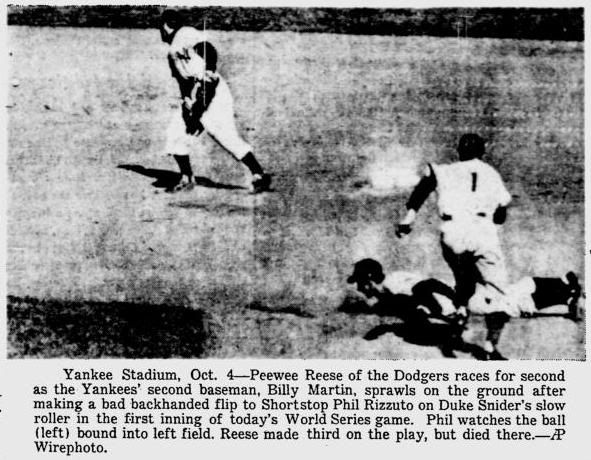
Their World Series opponent was the Brooklyn Dodgers for the fourth time in seven years. The Yankees had won each previous matchup, but Brooklyn had set a franchise record with 105 wins that season. After the Yankees won the first two games the Dodgers bounced back to win the next two, highlighted by Carl Erskine's then-record 14 strikeouts in Game 3. The Yankees took back the series lead with a slugfest in Game 5, and they led the Dodgers in the ninth inning of Game 6 before Carl Furillo's two-run homer tied it. Undeterred, the Yankees won it in the bottom half of the inning on Billy Martin's RBI single. Several records for a six-game World Series were set, including 17 homers and 120 hits between the two teams, and 12 hits by Billy Martin.

Acknowledgements:

Baseball Reference
Baseball Almanac
Google News Archives

Saturday, April 10, 2010

PTWSW #49: The 1952 New York Yankees

Manager: Casey Stengel
Record: 95-59
Ballpark: Yankee Stadium
Owner: Dan Topping and Del Webb
GM: George Weiss
Coaches: Frankie Crosetti, Bill Dickey, Jim Turner

Future Hall of Famers: Yogi Berra, Mickey Mantle, Johnny Mize, Phil Rizzuto

All-Stars: Hank Bauer, Yogi Berra, Mickey Mantle, Gil McDougald, Vic Raschi, Allie Reynolds, Phil Rizzuto

Team Leaders, Batting

BA:
Mickey Mantle, .311
OBP: Gene Woodling, .397
SLG: Mickey Mantle, .530
OPS: Mickey Mantle, .924 (AL leader)
2B: Mickey Mantle, 37
3B: Phil Rizzuto, 10
HR: Yogi Berra, 30
RBI: Yogi Berra, 98
BB: Mickey Mantle, 75
SB: Phil Rizzuto, 17

Team Leaders, Pitching

W:
Allie Reynolds, 20
SO: Allie Reynolds, 160 (AL leader)
ERA: Allie Reynolds, 2.06 (AL leader)
IP: Allie Reynolds, 244.1
CG: Allie Reynolds, 24
SHO: Allie Reynolds, 6 (AL leader)
K/BB: Allie Reynolds, 1.65
SV: Johnny Sain, 7

Tidbits

Oldest Player: Johnny Mize (b. January 7, 1913)

Youngest Player: Mickey Mantle (b. October 20, 1931)

First to Leave Us: Ray Scarborough (d. July 1, 1982)

Last Survivor: Art Schallock (d. March 6, 2025)

First in Majors: Johnny Mize (debut April 16, 1936)

Last in Majors: Mickey Mantle (final game September 28, 1968)

First to Play For the Franchise: Charlie Keller (April 22, 1939). The veteran Keller returned to the Yankees for two games in September after suffering through two injury-plagued seasons with Detroit.

Last to Play For the Franchise: Mickey Mantle (September 28, 1968)

Pre-union Team: The 1946 Indians (Bob Kuzava, Allie Reynolds, Gene Woodling) and 1950 Senators (Bob Kuzava, Irv Noren, Ray Scarborough) each had three.

Reunion Team: The 1955 Orioles had seven: Bob Kuzava, Ed Lopat, Jim McDonald, Bill Miller, Art Schallock, Kal Segrist and Gene Woodling. Surprisingly, only four of those seven were part of the record-setting November 1954 blockbuster where a total of 17 players were swapped.

Season Summary

After winning three straight World Series the Yankees continued their run as the class of the American League in 1952. Sophomore Mickey Mantle had his first great season, taking over in center field for Joe DiMaggio and leading the AL with a 162 OPS+. The Yankees tied Cleveland for the best team OPS+, and were second only to the White Sox in ERA+. Their pitching staff was slightly below-average in walk rate, but their good strikeout rate and strong team defense helped make up for it. They were never out of first place after June 14, though the Indians once again stayed on their heels the whole way. The Yanks' lead was never more than five games during that period, and they won the pennant by only two.

The Yankees opposed the Brooklyn Dodgers in the World Series for the fourth time in twelve years. The teams alternated wins in the first six games, Brooklyn taking the odds and New York claiming the evens. Only one of the first six matches was decided by more than two runs, that being the Yankees' 7-1 victory in Game 2. Game 7 was another close one, and the most memorable play of the Series came in the seventh inning. With the Yankees leading 4-2 the Dodgers had the bases loaded and two out. On a tricky infield popup the pitcher and first baseman lost track of the ball, forcing young second baseman Billy Martin to run in for a diving catch that ended the inning and preserved the lead. The Dodgers didn't threaten in the final two innings, giving the Bronx Bombers their fourth straight World Series title.

The Yankees set two team records for a World Series: most home runs (10) and most pitching strikeouts (49). Vic Raschi and Allie Reynolds contributed 18 punchouts each to the hurlers' cause.


Acknowledgements:

Baseball Reference
Baseball Almanac
Google News Archives
Saturday, April 3, 2010

PTWSW #48: The 1951 New York Yankees

Manager: Casey Stengel
Record: 98-56
Ballpark: Yankee Stadium
Owner: Dan Topping and Del Webb
GM: George Weiss
Coaches: Frankie Crosetti, Bill Dickey, Tommy Henrich, Jim Turner

Future Hall of Famers: Yogi Berra, Joe DiMaggio, Mickey Mantle, Johnny Mize, Phil Rizzuto

All-Stars: Yogi Berra, Joe DiMaggio, Ed Lopat, Phil Rizzuto

Team Leaders, Batting

BA:
Gil McDougald, .306
OBP: Gil McDougald, .396
SLG: Yogi Berra, .492
OPS: Gil McDougald, .884
2B: Gil McDougald, 23
3B: Gene Woodling, 8
HR: Yogi Berra, 27
RBI: Yogi Berra, 88
BB: Gene Woodling, 62
SB: Phil Rizzuto, 18

Team Leaders, Pitching

W:
Ed Lopat, Vic Raschi, 21
SO: Vic Raschi, 164 (AL leader)
ERA: Ed Lopat, 2.91
IP: Vic Raschi, 258.1
CG: Ed Lopat, 20
SHO: Allie Reynolds, 7 (AL leader)
K/BB: Vic Raschi, 1.59
SV: Allie Reynolds, 7

Tidbits

Oldest Player:
Johnny Mize (b. January 7, 1913)

Youngest Player: Mickey Mantle (b. October 20, 1931)

First to Leave Us: Clint Courtney (d. June 16, 1975)

Last Survivor: Art Schallock (d. March 6, 2025)

First in Majors: Johnny Mize (debut April 16, 1936)

Last in Majors: Mickey Mantle (final game September 28, 1968)

First to Play For the Franchise: Joe DiMaggio (May 3, 1936)

Last to Play For the Franchise: Mickey Mantle (September 28, 1968)

Pre-union Team: The 1946 Browns (Tom Ferrick, Jack Kramer, Bob Muncrief, Fred Sanford) and 1946 Indians (Tom Ferrick, Bob Kuzava, Allie Reynolds, Gene Woodling) each had four.

Reunion Team: The 1952 Senators had five: Tom Ferrick, Jackie Jensen, Bob Porterfield, Spec Shea and Archie Wilson.

Accomplishments

Yogi Berra, AL MVP
Gil McDougald, AL Rookie of the Year
Allie Reynolds, no-hitters on July 12 and September 28

Season Summary

After two straight World Series titles things looked pretty rosy for the Yankees. They were the deepest team in the league, and promising youngsters Mickey Mantle and Gil McDougald were joining the lineup. Their primary weapon was offense. They led the league in runs per game and OPS+, tied the Indians for the home run lead and finished second only to the White Sox in stolen bases (with a much better success rate). On run prevention they were pretty darn good too, allowing the second-fewest runs per game, having one of the better team ERA+'s and leading in strikeout-to-walk ratio. Their DER was the AL's third-best.

The first half of the season saw a tight four-team race between the Yankees, White Sox, Red Sox, and Indians. The White Sox dropped out with a late-July slump, and in early August the Red Sox had a slump of their own which secured their spot in third place, though they remained within striking distance for the rest of the season. That left the Indians as the Yankees' main challenger. The two teams went back and forth until Cleveland ran out of steam in September. The Indians lost 10 of their last 14 games while the Yankees kept surging, and New York clinched on September 28 by sweeping Boston in a doubleheader.

The Yankees' World Series opponent was the New York Giants, who'd mounted an unlikely September comeback to tie the Dodgers for first place, then beaten Dem Bums in a best-of-three series to decide the pennant. Bobby Thomson's three-run homer in the final game of the playoff lifted the Giants to victory, and they were still riding that momentum when they faced the Yankees. After three games the National Leaguers led the Series 2 to 1, but a rainout delayed Game 4 an extra day. The Yankees seemed to regroup after that, winning the next two behind brilliant pitching performances by Allie Reynolds and Ed Lopat. The Giants, trailing by three runs in the ninth inning of Game 6, loaded the bases with nobody out, but could only push two across the plate. Right fielder Hank Bauer (filling in for an injured Mantle), made a sliding catch of Sal Yvars' line drive for the final out, giving the Yanks their third straight World Championship.

It was the final World Series for Yankee legend Joe DiMaggio, who officially announced his retirement that December. Young Mantle would be shifted to center field as the Yankee Clipper's direct successor.

Acknowledgements:

Baseball Reference
Baseball Almanac
Google News Archives